Services / Chat experience design
Chats that feel like talking to someone good at their job.
Conversational design for AI assistants and chatbots: a persona with a clear job, flows that get people answers, and a person one tap away when it matters.

Anatomy of a good chat
Every message is a design decision.
An example conversation, modelled on the chat on our own site, with the reasoning behind each turn.

Hi, I'm Candice, DesignFIT's concierge. I can help with plans, a free call, or your project. What brings you here?1
A new projectI'm a client, I need helpJust lookingI'm a client, I need help
Leo looks after our clients. I'll pass you over with what you've told me, so you don't have to repeat yourself.2
- Leo joined the chat

Hi, I'm Leo. Before I share anything about your project, I'll email you a 6-digit code. What's your email?3
Thanks Sam, you're verified. Your homepage is in round 2 and your review is next. Want me to open a ticket for the team?4
- A quiet minute later
Is there anything else I can help with?5
End chatI have another question
- 1Say who you are, and what you can do.
A name, a role and three common paths as chips. People tap far more readily than they type.
- 2Hand off out loud.
The visitor always knows who they're talking to, and the next agent gets the context, so nobody repeats themselves.
- 3Verify before anything private.
A one-time code by email, with the reason given up front. Trust is earned before details are shared.
- 4Answer with the specific thing.
The real status, then one clear next step. A ticket goes to a person when it should.
- 5Notice silence, end gracefully.
After a quiet minute, a gentle nudge with an End chat chip. Chats close politely instead of hanging forever.
What customers say
People don't hate AI. They hate being stuck with it.
of customers would prefer companies didn't use AI in customer service.
Gartner, survey of 5,728 customers, 2024would consider switching to a competitor if they found out a company was going to use AI for service.
Gartner, survey of 5,728 customers, 2024worry about AI service: that it will get harder to reach a person.
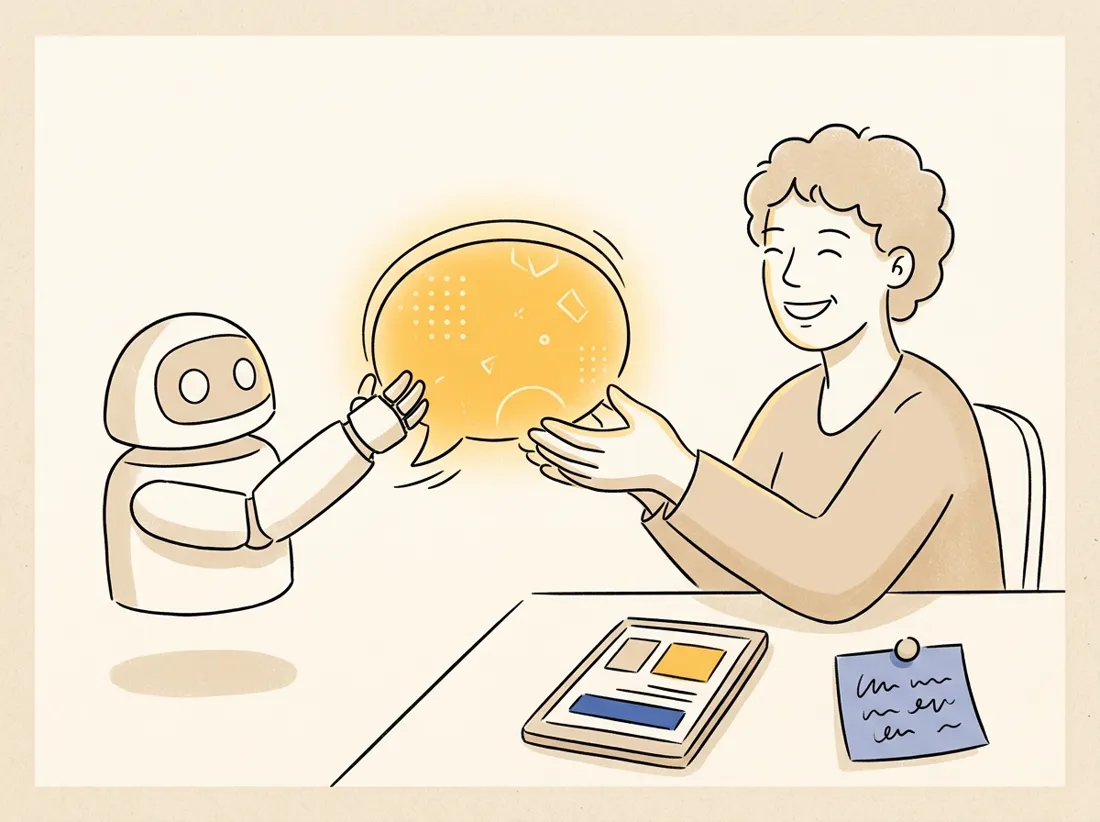
Gartner, survey of 5,728 customers, 2024So we design AI chat that earns its place, and never hides the way to a person.
The handoff
The best bots know when to step aside.
- 01Notice
Spot the moment a person is needed: a question outside the bot's scope, frustration, or a request to talk to someone.
- 02Say who's next
Name the person or team taking over and when they'll reply. No mystery queues.
- 03Carry the context
The transcript, the verified identity and a short summary travel with the handoff.
- 04Follow through
A ticket, an email confirmation, and the chat stays open to pick up later.
Persona and voice
Give it a job, a voice and some lines it never crosses.
A clear name and job, like a concierge for new visitors and a support specialist for clients. Each has one job, and says so.
CandiceWebsite conciergeWarm, plain and brief. We set it on a few dials and write sample replies for the hard moments, like bad news or a complaint.
What it never does: invent prices, share private details before verification, or stand between a customer and a person.
- Never guesses a price
- Never shares before verifying
- Always offers a person
How we built our own
We use what we design.
The chat on this site is our own work, and our test bench. Open it and try it: everything here is live.
- Two AI agents with their own names, photos and jobs: Candice for new visitors, Leo for clients
- Candice hands clients to Leo in the same chat, with everything said so far
- A 6-digit email code before Leo shares anything about a project
- Quick-reply chips for the common paths, and voice notes
- A nudge after a quiet minute, and a polite End chat
- Signed-in clients see their past chats and can pick one up again
- Every transcript, reason and ticket lands in our admin, and the team gets an alert
What you get.
- Persona and voice guide
- Conversation flow maps
- Message and microcopy library
- Quick replies and chips
- Handoff and escalation rules
- Verification and privacy flows
- Chat widget design, web and mobile
- Transcript review and analytics plan
- 01Kickoff call
Who's chatting, why, and what a great outcome looks like.
- 02Round 1
Persona, the main flows and a clickable chat prototype.
- 03Your review
We run real conversations through it together.
- 04Round 2
Edge cases, handoff rules, the widget design and the copy library.
- 05Launch
Handoff to your developers and a plan to review transcripts after go-live.
Fixed-price projects from $1K, or a design team on a monthly retainer from $3K. One-off projects are 50% to start, 50% on launch.
See pricingGood questions.
Designing the rest of the product too? See Interface and app design and Mobile app design.
Which AI platform does it work with?
We design the experience, the rules and the copy, so it works with the platform you use or plan to use. Our own assistants run on OpenAI models.
Will it replace my support team?
No, and it shouldn't try. We design chats that answer the common questions well and make a person easy to reach for everything else.
Can you design the chat widget itself?
Yes: the launcher, the conversation view, chips, attachments, verification and the closing moments, for web and mobile.
How do we know if it's working?
We set up a transcript review and a handful of measures, such as how often people reach a person and why, then tune the flows from what real chats show.
What does it cost?
Fixed-price projects start at $1K, and a design team on a monthly retainer starts at $3K. One-off projects are 50% to start and 50% on launch.
Your team
The people you'll work with.
Real designers, a project manager who runs your timeline, and an account manager you can call. Our AI helpers handle the busywork so they can focus on the craft.
 Kevin K.Designer
 Mel J.Project Manager
 Simon R.Designer
 Herman A.Account Manager