Agency vs Freelancer Web Design: Real Costs in 2026
The cheapest design quote can cost more once you add payroll, software, handoffs and your own management time.
On this page
- What are you actually comparing?
- The real cost formula
- Side-by-side: how each model works
- In-house designer: the full cost of dedicated capacity
- Freelancer: flexible expertise, with more coordination on your side
- Agency or studio: paying for a connected delivery team
- An illustrative first-year cost comparison
- Compare the design decisions, not just the staffing model
- How to check a quote or employment plan
- Which option should you choose?
- A five-question decision checklist
- The practical verdict
Agency vs freelancer web design is not just a comparison of day rates. The right choice depends on the total cost of getting a useful website designed, built, tested and improved, including your time coordinating the work. Use the DesignFIT comparison page as a starting point, then compare the actual deliverables and responsibilities behind each quote.
A freelancer is often the better fit for a tightly defined task. An in-house designer can make sense when the work is steady enough to fill a role. An agency or studio is useful when you need several disciplines working together and want less delivery management on your side. None is automatically better: the design decisions, quality controls and people responsible for execution determine whether the work helps your business.
What are you actually comparing?
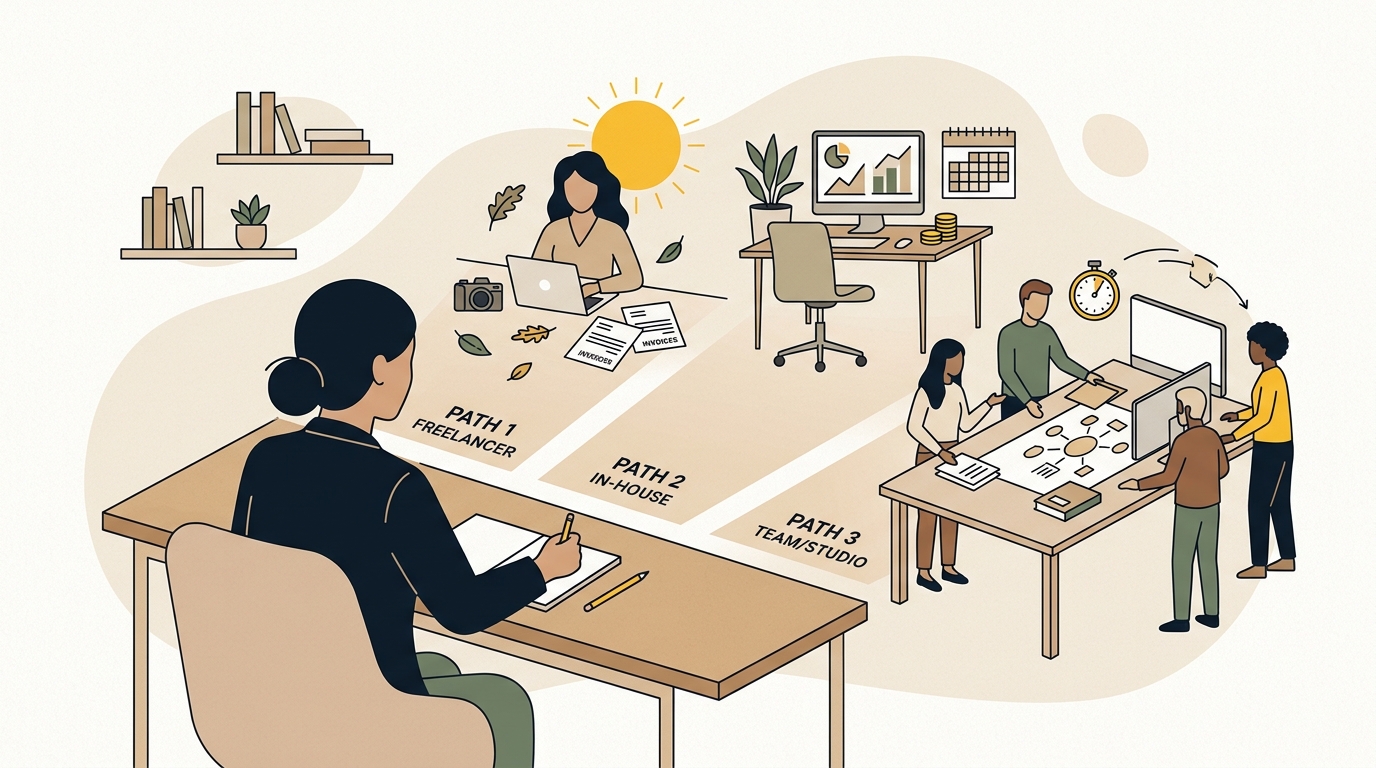
You are comparing three ways to assemble the people, time and expertise needed to reach a business outcome. That might be a new website, a better enquiry journey, a more consistent brand, or a stream of landing pages. You are not simply comparing one person’s hourly rate with another provider’s invoice.
A fair comparison starts with a defined scope. For a website, that could include discovery, site structure, content planning, visual design, responsive layouts, development, accessibility checks, analytics setup, launch support and post-launch improvements. Ask each option to state which parts are included, which are excluded and who will do them.
The difference matters. A low quote for visual design may not include development, copywriting or browser testing. A salary may look expensive, but the employee could also handle campaign pages and product updates. A studio’s project fee can include coordination and quality assurance, but only if those responsibilities are genuinely in the proposal.
This is why the DesignFIT website design service should be compared by scope and intended result, not as a price detached from the work. A visually polished homepage is not the full product. The site also needs to guide visitors, work on mobile, load reliably and make its information understandable to people and search systems.
The real cost formula
Use this formula to estimate the cost of each staffing model:
Total cost = external fees or salary + employment on-costs + tools and equipment + recruitment and ramp-up + specialist handoffs + your management time.
Then add a final question: what is the cost of waiting, rework or a missed opportunity if the project does not move forward as planned? That impact is difficult to predict, so do not make up a dollar figure for it. Instead, identify the practical risk. For example, a delayed launch may mean another month of sending paid traffic to an outdated page.
Founder time belongs in the calculation even when it does not appear on an invoice. If you spend your evenings writing briefs, chasing assets, combining feedback and testing pages, that time is being used. Estimate the hours and multiply them by a reasonable value for the work you could otherwise do. It is an internal planning estimate, not a universal hourly rate.
For an employee, include the costs beyond base pay. Depending on the country and the employment arrangement, that may mean retirement or superannuation contributions, payroll taxes, insurance, paid leave, equipment, software and recruitment. These costs vary by location and circumstances. The US Bureau of Labor Statistics overview of web and digital interface design work is useful context for the role, but it is not a salary quote for your business or your local market.
The BLS also publishes employer compensation data that separates wages from benefits. Its Employer Costs for Employee Compensation data illustrates why base pay alone is not the full employer cost. For an Australian estimate, use a calculator that lets you enter your location and assumptions, such as Use Multiplier’s Australian employment cost guide or ScaleSuite’s employee cost calculator. Check the inputs rather than treating any generic multiplier as your exact cost.
Tools and equipment are another variable. An in-house designer may need design software, image or font licences, a suitable computer and a screen. Software plans and licence terms change, so check the current vendor price and what each seat permits. For example, Adobe’s Creative Cloud plans for teams can help you check current business options. A freelancer or studio may already cover these costs in its fee, but confirm whether stock assets, fonts and third-party subscriptions are included or billed separately.
Side-by-side: how each model works
| Factor | In-house designer | Freelancer | Agency or studio |
|---|---|---|---|
| How you pay | Salary and employer costs, whether workload is full or light | Project fee, hourly rate or retainer for agreed work | Project fee or retainer for an agreed team and scope |
| Capacity | Available internally, subject to priorities and leave | Bought for a defined amount of work or time | Access to a planned mix of specialist capacity |
| Breadth | Depends on one hire’s skills; other expertise may need adding | Usually strongest in a defined specialism | Can bring strategy, design, development and QA together, depending on the team |
| Management | You set priorities, review work and manage development | You brief, give feedback and coordinate other suppliers | A project lead may manage delivery; you still make business decisions and approve work |
| Continuity | Strong knowledge of internal context, with leave and retention risks | Depends on the individual’s availability and documentation | More continuity options, but confirm who is assigned and how handovers work |
| Best fit | Recurring work that reliably fills a role | A contained task with a clear brief | A connected project or ongoing programme that needs multiple skills |
This table describes common arrangements, not guarantees. Some freelancers work with trusted developers and copywriters. Some studios are small teams where one person handles multiple roles. Some businesses hire an in-house designer and still use external specialists. Inspect the actual team and workflow behind the label.
In-house designer: the full cost of dedicated capacity
An in-house hire gives you a person who can learn your products, customers, internal language and approval process. That context can be valuable when design work arrives steadily: product updates, campaign pages, sales materials, website improvements and brand applications. A designer embedded in the business can also spot inconsistencies before they become a string of separate requests.
But salary is only the first line in the budget. Add the employer costs that apply to your location, the equipment and software you provide, recruitment, onboarding and the time it takes for a new hire to understand the business. For a small team, also consider the work needed to manage priorities, review performance and find specialist help when the designer’s skills do not cover a task.
The main financial risk is paying for capacity you cannot use consistently. Website design work often comes in uneven bursts. You may need a lot of input before launch, then have fewer design tasks for a while. That does not make a hire a bad choice. It means you should ask whether the role will have enough meaningful work across the whole year, not just during the redesign.
Another risk is assuming one person can cover every discipline at a high level. Someone may be strong at visual identity and page design but not want to write frontend code, audit accessibility, configure analytics or manage search implementation. A sensible job description distinguishes core responsibilities from work that will be contracted out.
In-house tends to fit when:
- Design requests are frequent and reasonably predictable.
- The role includes more than one website project, such as ongoing campaigns or product work.
- A manager can set priorities and give useful feedback.
- You can budget for employment costs, tools, leave and learning, not only salary.
- You have a plan for specialist work outside the designer’s skill set.
It is less compelling when the main need is a single website project followed by occasional updates. In that situation, a permanent salary may commit you to more capacity than the work requires. You can still hire internally, but compare the full annual cost with the price of buying specialist support when needed.
Freelancer: flexible expertise, with more coordination on your side
A freelancer can be a strong choice for a well-scoped job. Examples include redesigning a few key pages, creating a set of campaign assets, improving a specific checkout journey or designing a small brochure website. You agree a scope, pay for the work and avoid adding a permanent role to payroll.
This model is particularly efficient when you already know what needs doing and can make decisions promptly. Provide the content, brand assets, target audience, technical requirements and one person responsible for feedback. The clearer the brief, the less time both sides spend discovering basic requirements during production.
The hidden cost is coordination. A founder may need to decide the site structure, supply copy and images, organise approvals, review mobile layouts, arrange development and test the finished pages. If you hire a designer, a separate developer and a copywriter, you become the connecting point between them. That can work, but include your time in the budget and allow for the handoffs.
Before signing, ask what happens at each handoff. Will the freelancer provide responsive designs, component states, exported assets, specifications and implementation support? Who builds the website? Who tests forms, links, browser behaviour and mobile layouts? Who owns the final files? Clear answers prevent a design file from being mistaken for a finished website.
A freelancer can also be a single point of failure. If the person becomes unavailable, another contractor may need to understand the brief, files and decisions. Ask how they document the work, what availability they can commit to and whether the project has milestone dates. Do not assume that a freelancer is unreliable; simply plan for continuity rather than relying on one person’s memory.
Freelancing tends to fit when:
- The task has a clear boundary and a measurable deliverable.
- You can provide the necessary content and make decisions on time.
- You have the technical ability to review the work or a developer ready to take it on.
- You are comfortable managing the relationship and any other suppliers.
- You need specialist help for a short period rather than a continuous workload.
It is a weaker fit when the brief is still vague, multiple departments need to agree on the site, or the work spans research, brand, design, development and ongoing optimisation. One freelancer might still lead that work, but check that they can resource it and price the full scope.
Agency or studio: paying for a connected delivery team
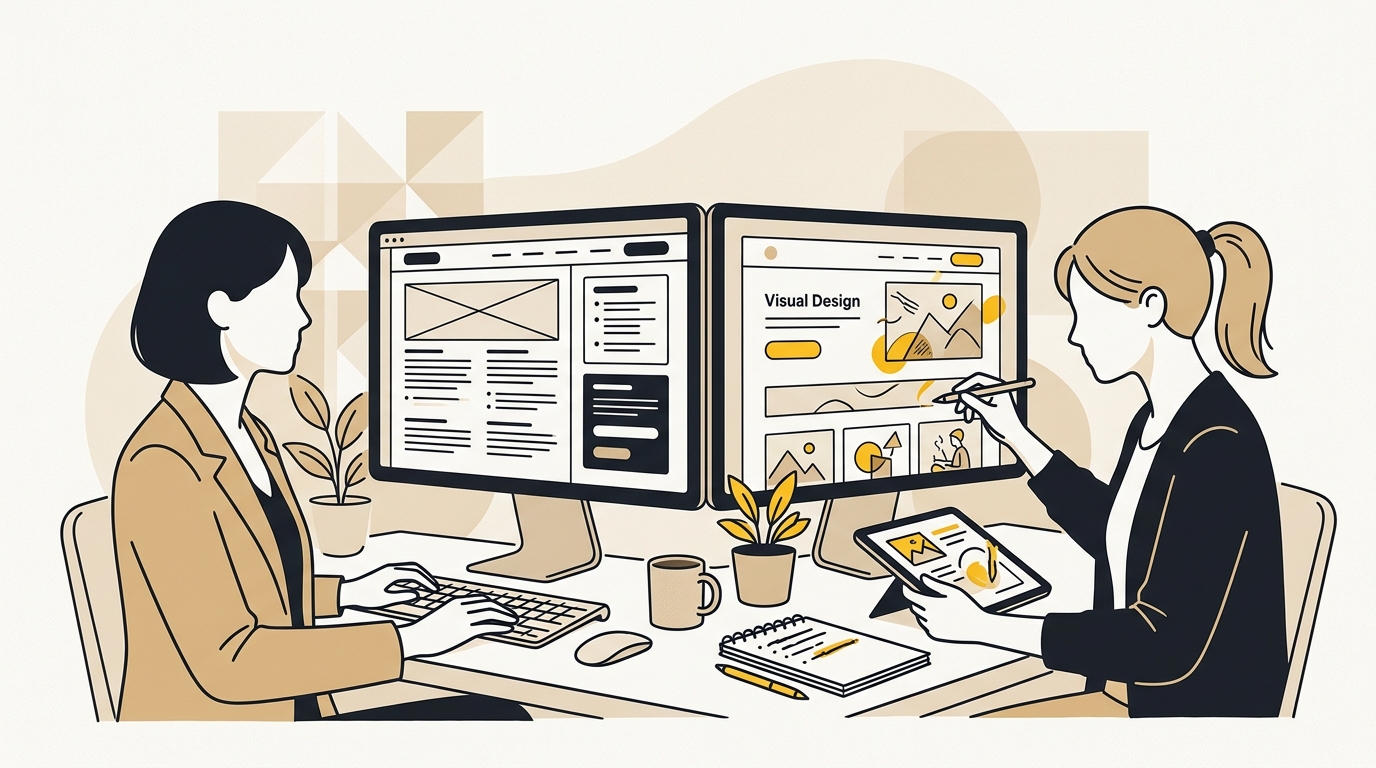
An agency or studio can bring multiple skills into one project: research, information architecture, visual design, development, content support, quality assurance or search expertise. The exact mix varies widely. The benefit is not simply having more people. It is having the right responsibilities connected so that a decision in one area does not create avoidable problems in another.
For example, a designer can consider the content structure while laying out a page, instead of treating headings as final decoration. A developer can flag a technically costly interaction before it is approved. A QA process can catch a form that looks correct but fails on a phone. Someone responsible for search can check that the page communicates its subject clearly through headings and meaningful page structure. The value comes from coordinated decisions, not the agency label.
A project fee may look higher than one freelancer’s quote because it includes more than design hours. It may cover planning, meetings, project management, multiple specialists and testing. Check what the team will actually provide, how many review rounds are included, what counts as a change in scope, and who will do the day-to-day work.
The risks are real. A senior person may lead the sales conversation while another person delivers the work. A studio may assign less experienced staff than you expect. An account process can add meetings without improving decisions. Ask to meet the people who will work on the project, see relevant examples and request a named lead. Ask how the lead checks work and how the team handles changes.
An agency or studio tends to fit when:
- The project joins several disciplines, such as strategy, design and development.
- The website is important to sales or lead generation and needs more than a visual refresh.
- Your team does not have time or expertise to coordinate several suppliers.
- You want a defined process, milestones and quality checks.
- You need ongoing design work but do not want to employ every specialist full time.
A studio is not automatically the best option for every redesign. If you only need a few simple pages and have a developer ready, the extra process may be unnecessary. Ask what the team removes from your workload, what it adds to the outcome and whether the proposed scope matches the risk of the project.
An illustrative first-year cost comparison
The table below is a worked example, not a market rate or promise of what a provider will charge. It uses Australian dollars and assumptions supplied for comparison: an in-house salary of $90,000, an illustrative 30% employment load, software and equipment of $3,800, founder time valued at $100 an hour, and the fees shown in the table. Replace every assumption with your actual quote, pay, tax position and time estimate.
The goal is to compare a website build plus a year of iterative design work. The three options are only comparable if they deliver similar outcomes. A freelancer’s quote that excludes development cannot be compared directly with a studio fee that includes development and QA.
| Cost item, illustrative Year 1 | In-house | Freelancer | Studio |
|---|---|---|---|
| Salary or service fees | $90,000 | $38,000 | $54,000 |
| Employment on-cost assumption | $27,000 | Not applicable in this model | Included in provider fees |
| Software, fonts and equipment assumption | $3,800 | Assumed included | Assumed included |
| Founder management time | $10,000 | $25,000 | $2,600 |
| External development or handoff | $8,000 | $5,000 | Assumed included |
| Illustrative total | $138,800 | $68,000 | $56,600 |
The arithmetic is deliberately transparent. The in-house total adds $90,000 salary, $27,000 assumed on-costs, $3,800 tools and equipment, 100 founder hours at $100 an hour, and $8,000 for external development. The freelancer total assumes an $8,000 build plus $2,500 per month for twelve months, 250 founder hours and $5,000 in additional development or handoff work. The studio total assumes a $12,000 build plus $3,500 per month for twelve months, and 26 founder hours at the same assumed rate.
These figures are a planning exercise, not evidence that one model is always cheaper. Change the assumptions and the result changes. If the business has enough predictable work to keep an employee productively occupied, the value of internal availability may justify a larger annual cost. If the founder can manage a freelancer in two hours a week rather than five, the freelancer scenario drops. If a studio quote excludes development, add it before comparing.
This example also leaves out uncertain benefits such as higher conversion, fewer defects or improved search visibility. Do not treat those as guaranteed savings. Instead, evaluate the proposed design work against useful business measures: qualified enquiries, completed purchases, form completion, mobile usability, page speed and the time needed to publish future updates. Your measurement plan should state what you will track and how you will interpret it.
Compare the design decisions, not just the staffing model
Each staffing option can deliver strong design. The question is whether the scope assigns responsibility for the decisions that affect how the site performs.
| Design decision | Why it matters | What to check in the proposal |
|---|---|---|
| Page hierarchy and content order | Visitors need to understand what you offer, who it is for and what to do next | Who plans the page structure? Is it based on your customer and business goals, or copied from a visual reference? |
| Typography and visual emphasis | Clear type sizes and contrast help people scan content and find key actions | Are headings, body text, links and calls to action defined consistently and reviewed in real page layouts? |
| Mobile and responsive behaviour | A desktop design does not explain how content and controls work on a narrow screen | Are mobile layouts designed and tested, or left for a developer to interpret? |
| Performance and implementation | Heavy assets and unsuitable implementation choices can make a site slower and harder to use | Who optimises images and checks the built pages? What testing is included? |
| Accessibility and usability | People need to read, navigate and operate the site in different ways | Is accessibility considered during design and checked during implementation? Which standards or checks are in scope? |
| Search-friendly content structure | Clear page subjects, headings and internal links help people and search systems understand information | Who owns the content hierarchy, page titles, semantic markup and any structured data? What is included, and what is not? |
| Reusable components | Consistency makes future page updates easier and reduces one-off design decisions | Are patterns documented and built for reuse, or will each page be assembled independently? |
A design file is an input, not proof of a working website. Review the live build on a phone, check the main user journeys and test the important forms. Ask whether the design system, if one is included, will be useful to the team maintaining the site. Reusable patterns should make future work easier, not create a complicated framework no one wants to touch.
Search visibility also needs careful language. Good information architecture and clear semantic structure make content easier to understand. They do not guarantee a particular ranking or an AI citation. If search is commercially important, define the technical and content work in the scope, then measure visibility and qualified traffic over time rather than treating a promise of rankings as a deliverable.
How to check a quote or employment plan
Before you choose, request a written breakdown for the same scope from each option. It does not need identical line items, but it should make responsibility and exclusions visible.
- Write the outcome. State what should change for the business. For example: replace an outdated service site with a clearer route from service pages to enquiry forms. Avoid defining success only as “make it modern”.
- List the deliverables. Name the pages, templates, content work, integrations, responsive layouts, development, testing and launch support you expect.
- Name the owner for each task. Decide who supplies copy, approves design, builds pages, checks accessibility, configures analytics and resolves defects.
- Count your own time. Estimate hours for briefing, feedback, asset collection, meetings and testing. Use a realistic internal value for that time and apply the same method to each option.
- Check total employment cost. For an in-house role, get current local advice or use a location-specific calculator. Include the costs that apply to your business, not an unexamined generic percentage.
- Check continuity. Ask how files, decisions, passwords, design components and development notes will be handed over if a person leaves or a contract ends.
- Set acceptance criteria. Agree how you will review the finished work: key page behaviour, mobile layouts, working forms, content accuracy and agreed launch requirements.
- Compare change control. Find out how extra pages, revised content or new features are priced. A low starting quote can become costly if the scope is unclear.
For employed roles, also separate the cost of recruiting from the cost of keeping the role productive. Recruitment fees, advertising, interviews and onboarding are one-off or ramp-up costs, while salary and employment costs recur. The FairWorkmate hiring cost calculator can help prompt a broader checklist, but verify assumptions against your actual employment arrangements and professional advice.
Which option should you choose?
Choose an in-house designer when you have ongoing work across the year, someone who can set clear priorities and a role broad enough to make good use of the person’s time. Keep external development or specialist support in the plan where needed. The strongest reason is usually sustained internal demand and accumulated business context, not a belief that an employee’s time is automatically cheaper.
Choose a freelancer when the deliverable is contained, you can brief and review it, and you have a plan for any skills or production work outside the freelancer’s scope. This can be a sensible way to get specialised help without taking on a permanent role. Protect the budget by documenting requirements, feedback rounds, handoff files and ownership.
Choose an agency or studio when the website project combines disciplines, the cost of a weak launch is meaningful, or your team needs delivery coordination as well as design. Look for a team that explains its design reasoning, names who does the work and includes the implementation and testing you need. Do not pay for a large process that does not match the project.
Use a hybrid model when one option does not cover the whole need. An in-house marketer might own the content and priorities while an external studio handles a redesign. A freelancer could produce a campaign page while your existing developer builds it. A designer on staff might use an accessibility specialist for an audit. The key is to name one person who owns decisions and to agree how the handoffs work.
A five-question decision checklist
Before deciding, answer these questions:
- Is design work predictable enough to keep a full-time role usefully occupied across the year?
- Does the project need one specialist, or a connected team across strategy, design, development and testing?
- How much founder or manager time can you realistically spend briefing, reviewing and coordinating?
- Who will implement the design and take responsibility for the live website?
- What matters most: internal availability, a narrow specialist task, or coordinated delivery with less supplier management?
If your answers point to full-time recurring work, explore the in-house cost. If they point to one clear task and strong internal project management, seek a freelancer. If they point to several connected disciplines and limited management capacity, compare studios against a clearly written scope.
The practical verdict
There is no universally cheapest model. In-house staffing buys internal capacity but adds recurring employment and management responsibilities. A freelancer can keep the invoice focused, but may leave you coordinating the brief, other suppliers and implementation. An agency or studio can connect the disciplines and reduce some of that coordination, but only when the agreed team and deliverables justify the fee.
Compare the full cost of the outcome: salary or fees, on-costs, tools, handoffs and your time. Then check who is accountable for the decisions that shape trust, usability, mobile experience and conversion. For a commercial website, the best-value option is the one that delivers the right work to a quality you can use, with a process your business can support.
If you are comparing providers, start with the DesignFIT comparison page, review DesignFIT pricing and learn who we are and how we work. Ask for a scope that makes responsibilities, inclusions and next steps clear before you commit.
Key takeaway
Compare the full cost of getting a website designed, built and improved, including your management time, rather than choosing by salary or day rate alone.
Questions people ask
Is it cheaper to hire a freelance web designer or an agency?
A freelancer may have a lower initial fee, especially for a clearly defined task. The total can rise if you need to manage the project, hire a separate developer or pay for extra testing, so compare equivalent deliverables and include your own time.
What is the hidden cost of hiring an in-house designer?
Beyond salary, budget for the employment costs that apply in your location, equipment, software, recruitment and onboarding. Also consider whether there is enough continuous design work to use the role well and who will manage the work.
When should a business move from a freelancer to an agency?
Consider a studio when the project needs several connected skills, such as strategy, design and development, or when coordinating suppliers is taking too much of your time. Check that the studio will provide those disciplines and name the people responsible.
Can one web designer design and build a whole website?
Some designers also build websites, but their capabilities and the complexity they can handle vary. Confirm who is responsible for responsive implementation, testing, performance and any technical work your project requires.