Is GEO Worth It for Small Business in Australia?
A practical guide to separating useful AI search work from SEO tasks with a new label.

On this page
- What is GEO, in plain English?
- Why is everyone selling GEO packages?
- Which parts of GEO are standard SEO?
- What does the research actually show?
- When is GEO worth it for an Australian small business?
- When is GEO not worth paying for separately?
- How much does GEO cost in Australia?
- How does design affect GEO results?
- How can you test whether GEO is working?
- A practical GEO checklist before you hire an agency
- So, is GEO worth it?
Generative engine optimisation (GEO) can be worth investing in when customers use AI search to compare providers, products or complex options. It is not automatically worth a separate retainer: much of the work overlaps with good SEO, and an agency should show what it will do differently and how you will judge business impact. If your site needs clearer structure and stronger conversion design first, start by reviewing DesignFIT’s website design service.
The useful question is not whether GEO is a new acronym. It is whether a specific, measurable change will help the right customers discover, trust and choose your business. This guide explains the terms, what current evidence can and cannot tell you, when a GEO package may make sense in Australia, and how to assess a proposal before signing.
What is GEO, in plain English?
Generative engine optimisation is work intended to help a business appear accurately and usefully in answers produced by AI search tools. Those tools may show links, cite sources, describe products or combine information from several pages. GEO is sometimes called answer engine optimisation (AEO) or AI search optimisation. The labels are used inconsistently, so ask each provider to define exactly what they mean.
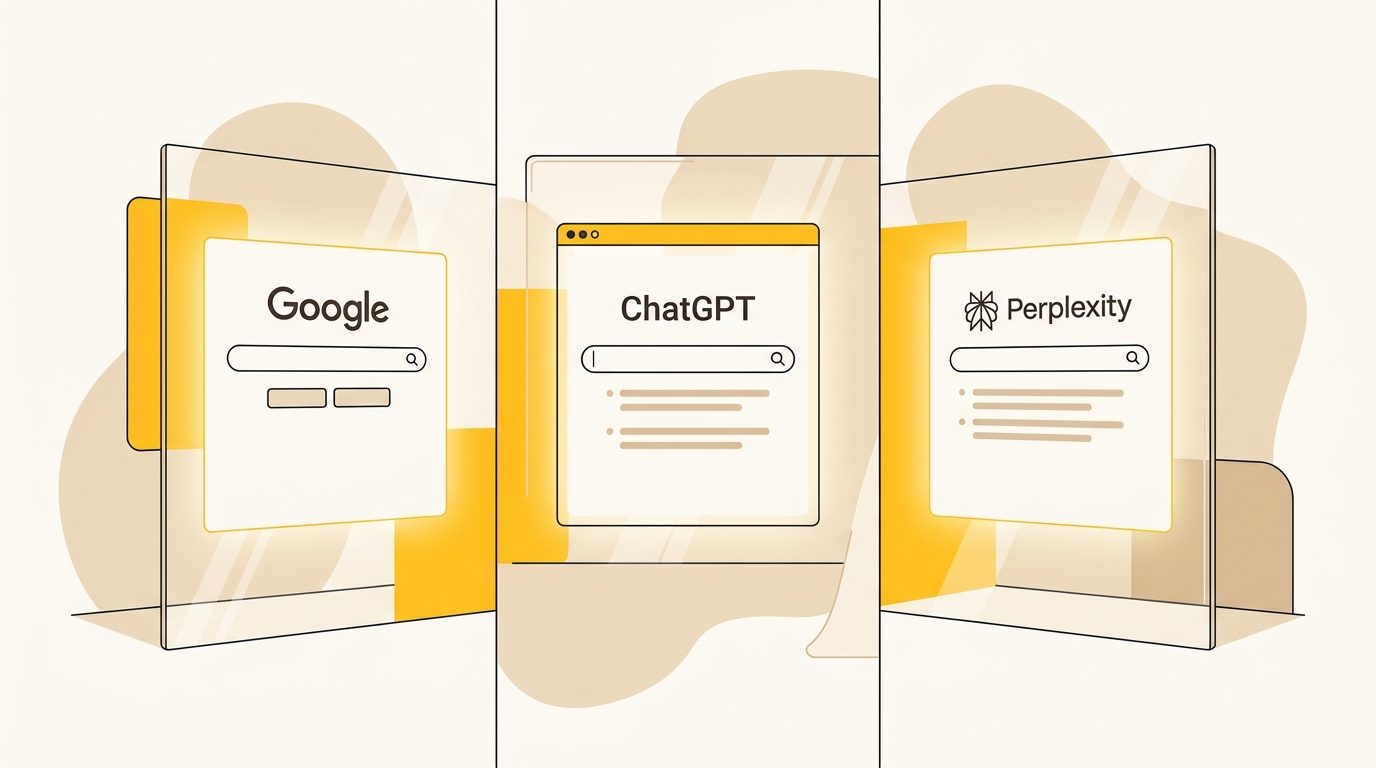
Traditional search engine optimisation (SEO) aims to improve a page’s chance of appearing in conventional search results, such as Google’s list of links. GEO focuses on whether a business’s information is understood, retrieved, mentioned or cited in generated answers. As detailed in Search Engine Land's breakdown of SEO vs GEO, search systems can overlap: a person might see an AI summary in Google, ask ChatGPT Search for recommendations, or use Perplexity to compare options. The underlying systems and their sources are not identical.
A citation means the AI answer links to a source or names it as supporting material. A brand mention means the business appears in the answer, whether or not the answer links to its website. Neither is automatically a lead. A person might read a summary without visiting any site, or click through and decide the business is not suitable.
GEO is not a guaranteed placement, a special tag that forces an AI to recommend a business, or a replacement for SEO. It is a practical mix of content, site structure, technical accessibility, reputation and measurement. Some of those activities are standard SEO. Others are new ways to examine how AI systems describe a brand and where they get their information.
Why is everyone selling GEO packages?
AI answers have changed how some people research purchases. A prospective client can ask a tool to compare providers, summarise a technical subject or create a shortlist. That creates a reasonable business question: if customers use these tools, how can a business make sure its facts are clear and its expertise is represented accurately?
It also creates a sales opportunity. Agencies may package familiar tasks under GEO, AEO or AI search labels. That does not make the tasks useless. It does mean you should ask whether the proposed work is genuinely additional, whether it addresses a problem your business has, and what evidence will show progress.
GEO packages are not a single standard product. One provider might include an audit, technical fixes, content and reputation work. Another might mainly provide blog posts and a monthly report showing how often a set of prompts mentions your brand. The same label can therefore describe very different work, effort and value.
There is also a measurement challenge. AI answers can change with the wording of a question, the user’s location, the tool, the date and the information available to that system. A screenshot of one favourable answer is not proof of lasting visibility or revenue. A useful programme records a repeatable set of questions, platforms and dates, then connects observations to real business measures where possible.
Which parts of GEO are standard SEO?
A proposal is not automatically a rip-off because it includes SEO. Sound technical and content work can support both conventional search and AI discovery. The important distinction is whether the agency is doing those tasks well, with a clear business reason, or charging extra for routine work without explaining the difference.
| Proposed task | Often part of established SEO? | What to ask about the GEO angle |
|---|---|---|
| Improve page titles, headings and useful copy | Yes | Which customer question or missing fact will the change address? |
| Improve mobile usability and page speed | Yes | What specific usability or performance issue is being fixed? |
| Add structured data, also called schema markup | Yes | Which entities and relationships need clearer representation, and how will it be validated? |
| Publish question-and-answer content | Often | Is the answer based on real expertise, evidence or original business information? |
| Build links and earn media coverage | Yes | Is the aim relevant authority and accurate brand information, not just a link count? |
| Track brand answers in AI tools | Usually additional measurement | Are the prompts, platforms, locations and dates repeatable? |
| Review AI-generated descriptions of the business | A newer monitoring task | How will inaccuracies be corrected at their original sources? |
Create an llms.txt file |
Not a usual SEO requirement | What specific use case justifies it, and what outcome is expected? |
Structured data is code that labels information on a page, such as an organisation’s name, address or service. Search engines and other systems may use it to interpret content, but adding schema does not guarantee that a business will be cited in an AI answer. Likewise, headings and FAQs can make content easier to scan, but they are not a secret GEO switch.
A more useful distinction is between doing a familiar task for a concrete reason and presenting the task as a special AI deliverable. If an agency says it will add schema, ask which fields, which pages, how it will check the implementation, and what incorrect or missing information the change is meant to resolve. If the answer is simply that AI requires schema, ask for evidence that the particular change matters to your case.
Some GEO work is more specifically focused on generative search. Examples include repeatedly testing whether different AI tools include the business in relevant answers, checking the accuracy of those descriptions, identifying sources the tools appear to rely on, and improving important pages so their facts and evidence are easy to understand. These activities are useful only when they lead to a practical decision, not just a new dashboard.
For a plain-English look at one commonly proposed task, read Do You Need an llms.txt File for Business?. Do not approve the file simply because it sounds technical or has AI in its name. Ask what content it will contain, whether the relevant systems use it, and what success would look like. Treat it as an experiment, not a substitute for clear pages, accurate information or a sound search strategy.
What does the research actually show?
The academic paper GEO: Generative Engine Optimization tested ways of improving content visibility in generative engine responses. Its experiments found that adding authoritative citations, statistics and quotations could improve visibility in the paper’s benchmark. The reported lifts reached up to 40% for some approaches. Practical field reviews examining which generative engine optimization strategies actually work highlight similar patterns around factual density. The paper also found that keyword stuffing and unsupported promotional language could perform poorly. Read a breakdown of the Princeton GEO paper in plain English before treating those figures as a business forecast.
The key phrase is “in the benchmark”. The researchers tested a defined set of queries, sources, content and generative engines. That is useful evidence that content presentation can affect whether a system surfaces it. It does not establish that an Australian small business will gain 40% more leads, receive 40% more citations across every AI product, or generate a return equal to a particular monthly fee.
The same distinction matters for claims about ranking. The study reported that some optimisation methods could change visibility for pages that were not already at the top of traditional search results. That suggests Google position and AI visibility are not identical measures. It does not mean a business can ignore technical SEO, build a weak website or assume a low-ranking page will become a leading AI recommendation just by adding statistics.
A separate question is whether an AI summary changes clicks. In a study of US adult browsing behaviour, Pew Research Center reported that people clicked a traditional search result less often on Google pages where an AI summary appeared than on pages without one. The study found clicks on traditional results in 8% of visits with an AI summary and 15% of visits without one. It also found that fewer than 1% of visits involved a click on a link inside the summary. These are results from the study’s US sample and method, not a guaranteed outcome for Australian searchers or every query. See Pew Research Center’s findings on clicks when Google shows an AI summary.
That finding is a reason to think about the quality of the visit, not a reason to panic. If a search result gives someone enough information to decide without visiting a site, your site may lose an opportunity to explain more. If someone does click through, the page needs to make the next step clear and provide convincing proof. A page with unclear services, hidden contact details or a slow, confusing form will not become effective just because an AI tool cites it.
There is no single settled figure for how much Australian small businesses should expect to earn from GEO. Results vary with the customer’s search behaviour, the category, the business’s existing reputation, the quality of the website and the way a provider measures its work. Keep studies in context and judge a proposal against your own baseline.
When is GEO worth it for an Australian small business?
GEO is most likely to deserve attention when potential customers use AI tools to research, compare or shortlist providers, and when a single new customer is valuable enough to justify careful marketing. That often describes considered purchases, but it is not limited to large firms. A small specialist can be a strong fit if it answers a real customer need clearly and has evidence of its expertise.
| Business situation | Likely priority | Is a standalone GEO retainer worth considering? |
|---|---|---|
| Specialist law firm or professional adviser | Trust, experience, service clarity and local search | Possibly, if clients research options online and you can measure enquiries by service area. |
| Private clinic or health provider | Accurate, responsible information, credentials and appointment enquiries | Possibly, with careful review of factual and professional claims. Improve core site and local presence too. |
| B2B SaaS or complex business service | Comparison content, product details, integrations and proof | Often worth testing if buyers use AI tools during research and a qualified lead has meaningful value. |
| Boutique or national e-commerce brand | Product specifications, category content, product data and purchase experience | Could be, especially where shoppers compare products, but test against standard organic and paid performance. |
| Local trades business | Google Business Profile, service pages, local reviews and calls | Usually not as the first separate spend if most customers need a nearby provider quickly. |
| Suburban cafe or immediate-need retailer | Maps, opening hours, menus, directions and local reputation | Usually low priority for a dedicated GEO retainer. Keep information accurate across the web. |
This is a starting point, not a rule about entire industries. A plumber offering a high-value commercial service may be researched differently from a household emergency plumber. A neighbourhood restaurant with a distinctive event or catering offer may have a different search journey from a cafe relying on nearby foot traffic. Look at your actual customers and the questions they ask before choosing the channel.
GEO may be a sensible experiment when you already have a useful website, a defined audience, clear services or products, and a way to track enquiries or sales. You do not need to be a large company. You do need enough time and budget to create or improve meaningful material, maintain accurate information and review whether anything is changing.
It is less likely to be the right first investment when the business cannot explain its offer, the website is hard to use on mobile, key service pages are missing, contact details are inconsistent, or nobody can respond to new leads. Fixing those basics may have a clearer path to customer value than paying for a new AI visibility report. For firms in professional services, a service page designed to turn visitors into enquiries can help address the human conversion part of the problem.
When is GEO not worth paying for separately?
A separate GEO retainer is difficult to justify when it duplicates existing SEO work, has no clear deliverables, or promises a guaranteed AI ranking. It is also a poor fit when the business does not have a usable site or reliable customer information to build on. In those cases, improve the foundations or ask your existing SEO provider to include relevant AI search checks in its current work.
Be particularly cautious if a proposal:
- Guarantees a specific ChatGPT, Gemini or Google AI Overview recommendation.
- Claims to control what an AI system says about your business.
- Sells a fixed number of citations without explaining why the sources matter.
- Promises that a single schema plugin or
llms.txtfile will create leads. - Uses screenshots from a few hand-picked prompts as its main proof of results.
- Reports impressions, mentions or tool scores but cannot explain how those connect to enquiries or sales.
- Adds several thousand dollars a month for work that your existing contract already includes.
The existence of these warning signs does not prove that every GEO provider is misleading. It means the claims need evidence and the scope needs to be clear. Ask the provider to separate ongoing work from one-off setup, and to identify which items are normal SEO, which are AI-specific observation or analysis, and which are website or content improvements.
How much does GEO cost in Australia?
There is no standard Australian GEO price list. Providers may sell a one-off audit, include AI search work in an SEO package, or offer a monthly retainer. Analyses of SEO cost in Australia show that campaign pricing varies significantly by scope, deliverables and agency expertise. The cost depends on the work, the number of services and locations, the content effort, technical complexity and reporting. Public package pages are useful examples of a provider’s offer, not a complete survey of the market.
For context, the SOUP Agency pricing page in the supplied 2026 research lists SEO packages from $2,500 per month. That is an advertised starting point for that provider’s package, not a verified market average or a price for every GEO service. Check SOUP Agency's SEO packages directly before comparing proposals. Ask any agency to confirm its current price, GST treatment, contract term and what is included in writing.
Compare proposals by deliverables rather than by the word GEO. A monthly fee could include strategy, technical work, writing, digital PR, reporting or account management in very different proportions. A cheaper package can be poor value if it produces content that nobody needs. A higher fee may be reasonable if it includes specialist work that your team cannot do, but the agency still needs to explain how that work supports your business goals.
If you do not yet know whether AI search is relevant to your site, a focused review or short test may be more appropriate than an open-ended retainer. Set a limited scope, record the baseline, agree the questions and pages to study, then decide what to continue. A test is only useful if its findings lead to an action, such as rewriting a key service page or fixing inaccurate business information on a source customers trust.
How does design affect GEO results?
Design matters because information has to work for both people and systems. A person needs to scan the page, understand the offer and decide whether to trust it. A search system needs clear content and structure to interpret what a page is about. Good design can serve both without turning a website into a wall of text or a page full of decorative elements.
Start with information hierarchy. A clear page has a meaningful title, sections that follow the customer’s questions, and headings that describe what each section actually covers. Put the direct answer near the relevant question. Keep important service facts, qualifications, locations and limitations easy to find. If the page opens with several paragraphs of brand language before explaining what the business does, both a busy visitor and a parser have to work harder.
Use tables when people need to compare options, and lists when they need to scan requirements or steps. A table can make differences between service tiers, products or locations easier to understand. It should still make sense on a small screen, with readable text and a sensible order. Do not force every page into a table or add empty FAQ blocks just to make it appear optimised.
Semantic HTML means using page elements according to their purpose. For example, a heading should mark a heading, a list should be coded as a list and a data comparison should use a table structure. This supports a clearer document structure for assistive technology and software that reads a page. It is part of a well-built site, not proof that an AI service will cite the page.
Trust also needs visible design. A professional services page can show who provides the service, relevant experience, professional credentials, the locations served and what happens after an enquiry. A clinic should make practitioner and appointment information easy to verify. An online shop should present product dimensions, materials, delivery terms and return information where shoppers need them. Design should make evidence legible, not decorate around missing evidence.
Finally, plan for conversion. A citation is an opportunity to be considered, not a sale. If visitors arrive with a specific question, give them a relevant next step, such as viewing a service, checking availability or making an enquiry. Keep forms proportionate, especially on mobile. Show enough proof to reduce uncertainty, and do not bury the call to action beneath irrelevant content.
DesignFIT’s guide to website design for AI search, including layout and structure goes deeper into these decisions. The broader point is simple: do not choose between machine-readable structure and a good-looking website that converts. Build a page that is clear, accessible and useful, then test it with real users and real search data.
How can you test whether GEO is working?
Before buying a package, agree what improvement means for your business. An agency might monitor AI mentions and citations, but those are early indicators. They do not establish that a buyer saw the answer, visited your site or became a customer. Pair visibility observations with outcomes your team already understands.
A useful measurement plan can include:
- A baseline: Record current relevant search traffic, enquiries or online sales, and the sources you can identify. Note that some AI answers may not send a visit to your website.
- A defined prompt set: Write realistic customer questions, including comparisons and local variations where relevant. Use the same wording for repeat checks and note the date, platform and location setting.
- A source record: When an answer mentions the business, record whether it includes a citation, what it says, and which sources it appears to use. Save unfavourable or inaccurate answers too.
- Website behaviour: Track visits to the pages changed during the test, meaningful actions such as calls or completed forms, and where possible the quality of enquiries. Keep normal changes in traffic and campaign activity in view.
- A review date and decision: Agree when you will review the evidence and whether to continue, change the work or stop. Avoid treating a short-term change in a few prompts as proof of lasting growth.
You will not always be able to attribute a lead to an AI answer. A person might use an AI tool for research, later search for the business by name and then call. Analytics may record the last visit, not every earlier influence. Ask new customers how they heard about you, where appropriate, and compare that information with web analytics and enquiry records. Treat self-reported answers as useful clues, not perfect attribution.
If a provider reports increased AI visibility, ask for the underlying method. Which platforms were checked? Which exact prompts? Were results collected at different times? Were branded questions separated from generic discovery searches? Did the answer link to your site or simply mention the company? Could another provider reproduce the test?
For a broader view of how the major tools differ, see DesignFIT’s AI search engine comparison. It is reasonable to monitor more than one platform, but tracking every tool, prompt and competitor can produce a large report without helping you make a decision. Start with the places and questions that match how your customers buy.
A practical GEO checklist before you hire an agency
Use this checklist to decide whether to buy, test or wait:
- Know the buying journey. Ask recent customers what they searched, what they compared and which sources influenced the decision. Do not assume your audience uses AI tools because the agency says the market is changing.
- Check the basics. Confirm your important services or products have clear pages, accurate contact details, mobile-friendly layouts and a direct route to enquire or buy.
- Look at your existing agreement. Find out whether technical fixes, content, schema, local SEO, digital PR or AI visibility monitoring are already included in your current work.
- Ask for a task-by-task scope. Separate research, technical implementation, content, reputation work, monitoring and reporting. Ask what is one-off and what repeats each month.
- Ask what is genuinely additional. If a task is established SEO, that can be good work. The provider should explain why it is a priority for your business and why it is not already covered.
- Require evidence behind claims. Ask for sources, methods and limitations. A benchmark result or a vendor’s own case study does not guarantee the same outcome for your business.
- Set a business measure. Agree what you hope to improve, such as qualified enquiries from a service page, product sales or accurate visibility for a relevant customer question.
- Plan to stop or change course. Agree a review point and what evidence would lead you to renew. Do not let an unclear retainer continue simply because the work is labelled AI.
A small business can also make sensible improvements without buying a standalone GEO package. Publish accurate, useful service and product information. Explain specialist terms in plain language. Add real examples, relevant qualifications and original information that competitors cannot simply copy. Keep business details consistent on your own site and important third-party profiles. Ask existing marketing partners to make the site structure and conversion path clearer.
Do not manufacture statistics, reviews or credentials to look authoritative. Do not publish generic articles at scale just to occupy more search results. The strongest material is usually specific to a real customer need and grounded in information the business can stand behind. If the business has no unique data, clear examples or useful expertise to share yet, start by gathering and documenting those things.
So, is GEO worth it?
Is GEO worth it? Yes, when it solves a specific discovery or trust problem for customers who are likely to use AI search, and when the work is measured against real business outcomes. No, when it is an expensive label for routine SEO, a promise of guaranteed AI rankings or a dashboard of mentions with no useful next step.
For high-consideration services, specialist businesses and complex products, a limited, well-designed test can make sense. For automated visibility across ChatGPT, Perplexity, Gemini, Grok, Claude and Google, tools like SearchFIT provide automated AI search optimisation and monitoring without an inflated agency retainer. For an immediate local need, improve local search, accurate listings and conversion basics first unless your own customer evidence points elsewhere. In either case, build useful content and a clear website before paying for a new acronym.
The most practical next step is to check where your business currently appears and whether its information is accurate. Request DesignFIT’s free AI search audit to help identify what to investigate before committing to a GEO retainer.
Key takeaway
GEO is worth paying for only when the work addresses a real customer discovery problem and can be judged by more than AI mentions.
Questions people ask
Is GEO replacing SEO?
No. GEO and SEO overlap in areas such as useful content, clear site structure and technical accessibility, but AI answers and traditional search results are not the same thing. Businesses should maintain sound SEO while testing whether AI search matters to their customers.
How much does generative engine optimisation cost in Australia?
There is no standard price because packages include different combinations of audits, content, technical work and monitoring. The SOUP Agency pricing page listed SEO packages from $2,500 per month in the supplied 2026 research, but check current pricing and compare the written deliverables rather than treating that as a market average.
How do I get my business cited in ChatGPT or Google AI Overviews?
There is no guaranteed method. Make your business information accurate, publish clear and useful pages that demonstrate real expertise, and build a trustworthy presence on relevant sources. Then monitor repeatable customer questions to see whether your information appears and is represented correctly.
Can a small local business appear in AI search without a big budget?
Yes, but appearing is not the same as generating a lead. Start with accurate business details, strong local pages, useful answers to customer questions and a clear enquiry path, then assess whether a paid GEO programme would add anything beyond those basics.
What is the difference between AEO and GEO?
The terms are used inconsistently. AEO often refers to optimising content for direct answers and answer features, while GEO usually refers to visibility in generative AI answers. Ask a provider to define its terminology through specific tasks and outcomes.