AI Visibility Audit: What We Check and What to Fix
A practical walkthrough of the website, content and brand signals that can help AI search understand your business.
On this page
- What is an AI visibility audit?
- What does an AI visibility audit check?
- How do you test whether AI search can find you?
- How to prioritise audit findings
- What can you fix this week?
- Do you need an llms.txt file?
- Common audit mistakes to avoid
- What should you expect from a professional AI visibility audit?
- A practical AI visibility audit checklist
An AI visibility audit checks whether AI search tools can find your business, understand what you offer and use reliable information about you in their answers. It reviews your website structure, key business facts, content and wider online presence, then prioritises practical changes rather than promising a particular ranking or citation. If you want a starting point, request a free AI search audit and use this guide to understand what a useful review should cover.
The aim is not to sprinkle artificial intelligence keywords across your site. It is to make your business clear to people and machines: what you do, who you help, where you work, what makes your offer credible and what a visitor should do next. Good design helps by giving those facts a visible, readable and meaningful place. You can explore the wider AI search resources or see how website design supports business results as you work through the checks.
What is an AI visibility audit?
An AI visibility audit is a structured review of how well your business can be discovered and represented in AI-generated answers. It looks at both your own website and the other sources that may help an AI system identify or verify your business.
Traditional search reporting often focuses on where a web page appears in a list of search results. AI search can work differently: a tool may generate a response from a search query, select information from several sources and show some of those sources as citations. Depending on the product and the question, it may mention a brand, link to its website, do both, or do neither. A single answer is not a stable position you can rely on.
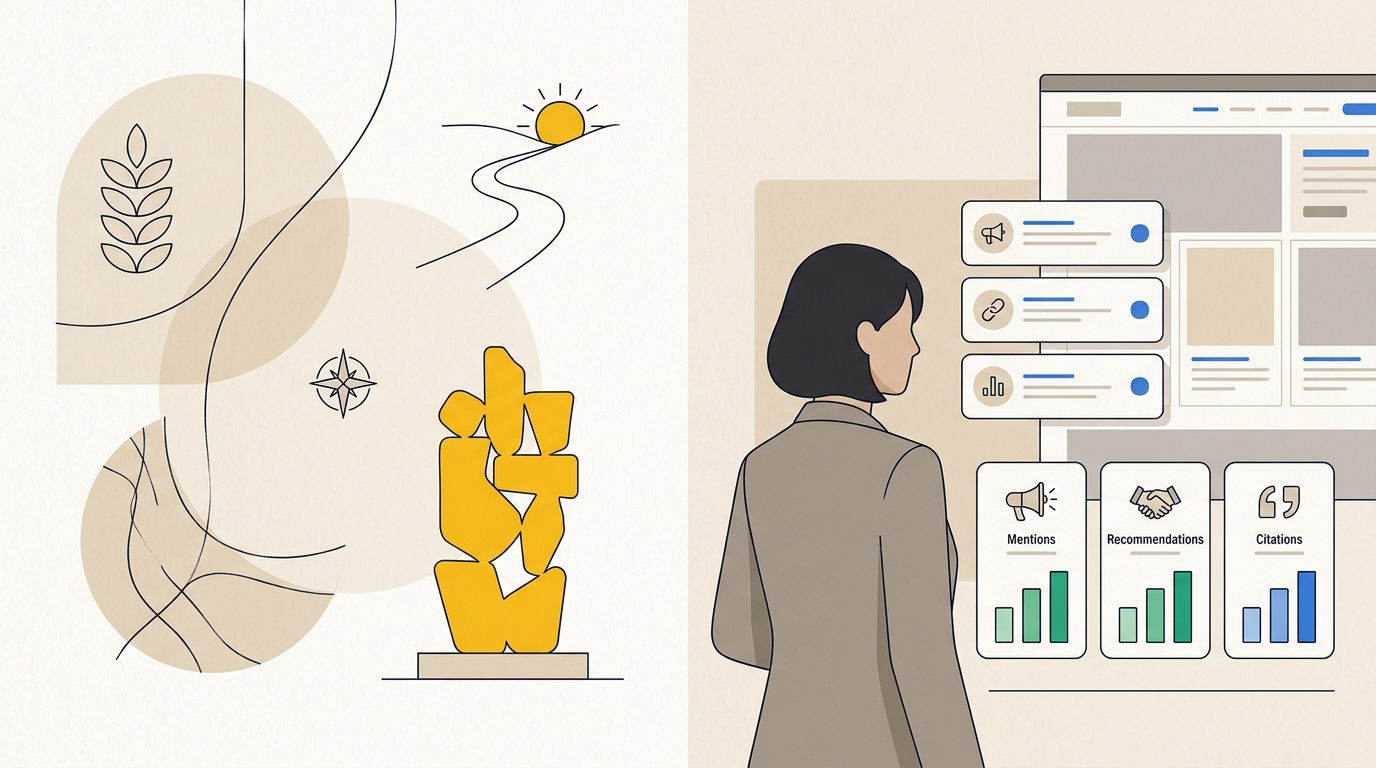
A citation is a source link shown with an answer. A mention is a business name included in the answer, whether or not a link is shown. Neither one alone proves that a visitor will become a customer. The useful question is whether the right people can find an accurate description of your business when they ask relevant questions.
An audit is a diagnosis, not a guarantee. It can identify unclear copy, inaccessible pages, inconsistent business information and weak evidence. It cannot force a particular AI product to cite you, and it should not promise a set number of mentions. AI answers change with the question, the search context, the tool and the sources available at the time.
What does an AI visibility audit check?
A useful audit connects five areas: discoverability, page structure, business identity, useful evidence and real-world visibility. Each area has a design consequence. A page can look polished but still hide the answer in a graphic, use headings in the wrong order or leave basic facts scattered across the site.
1. Can search systems reach the important pages?
First, check whether the pages you want discovered can be accessed. That includes service pages, product pages, contact details, location information, pricing where you publish it, and useful explanatory content. A page that is unavailable, blocked or only accessible through a broken route cannot reliably help a person or an automated system understand your offer.
The audit should review the site's robots.txt file, which gives automated crawlers instructions about which paths they may access. It should also check whether a hosting firewall, security tool or content delivery service is blocking requests. Robots.txt is a set of crawler instructions, not a security boundary. A disallow rule does not remove a page from the internet or guarantee that every crawler will follow it.
It is important to distinguish between bots that support live search and bots used for other purposes, such as collecting material for model training. Their names and policies differ by provider. Do not remove every restriction or allow every bot just because AI search exists. Ask your developer to confirm which systems you want to permit, what each system is used for, and whether your site's current rules match that decision.
A basic manual check is to open yoursite.com/robots.txt in a browser and look for rules that apply to relevant user agents or block important sections. Then test key pages in a private browser window and check that they load without a login, a broken redirect or a consent screen that prevents access. If you use a firewall, ask your provider to review its logs rather than assuming the robots file tells the whole story.
Some articles discuss AI bot access and tools for inspecting crawler behaviour, including this overview of how Perplexity may access website content and a Perplexity crawler simulator. Treat third-party explanations as a prompt for testing your own site, not as proof that every AI product behaves the same way.
2. Can a reader understand the page structure?
The next check is semantic structure. Semantic HTML is web code that tells a browser what a piece of content means, not just how it looks. For example, a heading is marked as a heading, a list is marked as a list and a table has labelled rows and columns.
A designer controls more than colour, spacing and imagery. The visual hierarchy should match the page's information hierarchy. A visitor should be able to scan the page and understand the main point, the supporting details and the next step. Headings should describe the section that follows. A visually attractive title should still use an appropriate heading element in the code.
Check that each page has one clear main heading and that section headings describe the content below them. A heading should not be selected simply because its font size looks right. If a short label needs a large visual treatment, style it with CSS instead of promoting it to a heading level that disrupts the content structure.
Look at how key facts are presented. If a service comparison exists only inside an image, the text may be difficult to read on mobile, inaccessible to people using assistive technology and harder for automated systems to interpret. Put the information in real page text. Use a semantic HTML table when readers need to compare several items across the same categories. Use headings and lists when a table would be awkward, especially on narrow screens.
The same principle applies to pricing cards, diagrams and feature grids. A card can be designed beautifully, but its name, price, inclusions and limitations should also exist as selectable text in the page. Do not use an image as the only place where essential information appears. Add concise alternative text to meaningful images, but do not treat alt text as a replacement for the visible explanation.
3. Are your business facts easy to identify?
An audit should compare the facts on your site with your profiles and other public references. Does your business name appear consistently? Is the contact information current? Are the services and locations described in the same way? Can a visitor tell whether two similar business names belong to different organisations?
Entity clarity means making it easier to distinguish your business from other people, organisations or products with similar names. Start with a clear About page, an accurate contact page and consistent names across your website and profiles. If you serve a particular region, state the locations plainly. If you work online across several countries, say so instead of implying that you have a local office in each one.
Structured data can also describe a page or organisation in a format that search systems may use. Schema markup is a standardised vocabulary added to page code to label information such as a business, a service or an article. JSON-LD is one format for publishing that structured data. It can help express what a page is about, but it does not guarantee that an AI answer will use or cite the information.
Only add structured data that accurately reflects visible, current information on your site. A schema block should not claim a location, rating, service or relationship that the page does not support. If your business has official profiles, linking to them from your site and keeping those profiles up to date can help people verify who you are. An audit should check consistency and accuracy, not add a long list of irrelevant properties to chase a technical score.
For local businesses, compare the name, address and phone number on the site with the information on the business's public profiles. For online businesses, check the legal or trading name, service area, support channels and product details. If something has changed, update the source pages and profiles rather than adding another conflicting version.
4. Does your content answer real customer questions?
Strong AI visibility starts with useful information, not an AI-specific writing trick. Look at the questions customers ask before they enquire or buy. A clinic might need to explain which services it offers and how to prepare for an appointment. A software company may need a clear comparison of plans, integrations and setup. A hotel may need accurate location, room and accessibility details.
Each important page should answer its main question early. A visitor should not have to scroll through a vague introduction, a full-screen animation and several generic claims before learning what the business actually does. Put a concise description near the top, then add the detail needed to make a decision. This is a strong design choice for people first. It can also make the page's subject and purpose easier to interpret.
For example, a service page might open with: “We design Shopify stores for growing Australian food brands. Our projects cover store structure, product pages and checkout design.” The page can then explain the process, likely project fit, inclusions, examples and how to start. That is more useful than a hero line such as “Ideas, reimagined”, which may sound distinctive but does not tell a new visitor what is on offer.
Useful evidence matters too. Replace broad claims such as “industry-leading” or “the best solution” with specifics you can verify: what the service includes, who delivers it, how a process works, what a product does and where the information comes from. If you publish a statistic, include its source and date. If a statement is an opinion or a promise, make that clear rather than presenting it as an established fact.
The Princeton and Georgia Tech research paper commonly known as the GEO study examined ways of improving how content appears in generative engine responses. It is useful background, but it should not be turned into a promise that adding a particular number of statistics or quotations will make your business visible. Read the GEO research paper for its methods and limitations, then apply the practical lesson carefully: make information specific, supported and useful instead of repeating keywords unnaturally.
5. What do independent sources say about your business?
Your website is not the only place people learn about your business. An audit should review the profiles that matter in your sector, such as professional directories, relevant review platforms, trade associations, social profiles and partner listings. The right sources depend on your audience. A local clinic and a business-to-business software company do not need identical profiles.
Check for factual consistency, not just the number of listings. Is the business name spelled correctly? Do the descriptions match the services you currently offer? Are old addresses, outdated product names or closed locations still visible? Are customer reviews on the platforms your prospects actually consult? Fix errors at the source where possible and avoid creating low-quality profiles simply to increase the number of mentions.
This is also where reputation and brand design meet. A consistent logo, business name, description and photography help people recognise the same organisation across pages and profiles. Brand consistency cannot manufacture trust, but inconsistency can create doubt. If you are reviewing the identity as well as the site, see DesignFIT's brand design service.
How do you test whether AI search can find you?
Do not decide your visibility based on one prompt asked once. AI answers can vary, and a test only tells you what happened for that particular wording, tool and moment. Use a repeatable set of questions that resemble the way potential customers search.
Build a small, fair prompt set
Start with questions that do not name your business. These test whether a system can surface you without being told to look for you. Include different types of intent:
- Category: “What should I look for in a [type of provider]?”
- Need: “Who can help a small business solve [specific problem]?”
- Location: “Which [type of business] serves [area]?”
- Comparison: “What are the differences between [approach A] and [approach B]?”
- Practical detail: “What does [service] normally include?”
Then run a separate set of branded questions, such as your business name plus “services”, “location” or “reviews”. These show whether the tool can retrieve or summarise information about you when the user already knows your name. Keep the two groups separate. A system finding you after being given your name is not the same as recommending you in an unbranded category search.
Record the exact wording, the platform, the date, whether a web-search feature was active, the answer and any links shown. Note whether your business was named, cited, described accurately or confused with someone else. Also record which competitors appeared. Do not treat the list as a definitive ranking or compare results from different products as if they used the same method.
If you repeat the test, keep the prompts and recording method consistent. A simple spreadsheet is enough for a small business. For each prompt, note the outcome in plain language: “not mentioned”, “mentioned with no link”, “cited”, “incorrect details” or “not relevant”. If a result changes, investigate what changed on the page or in the tool before assuming a website fix caused it.
AI visibility trackers can automate some repeated checks, but an automated score is only a measurement created by that product. Before buying one, ask which engines and prompts it checks, how often it runs them, whether it records citations and whether you can inspect the underlying answers. An overview of AI visibility audit tools can help you understand the category. Choose a tool only if its reporting answers a real business question that you cannot manage with a small manual test.
How to prioritise audit findings
A good audit does not hand over a long list of technical errors with no order. It separates the fixes that stop people or crawlers accessing useful information from improvements that refine an already functioning page. Prioritise issues by their impact on clarity, access and customer decisions.
| Priority | What you find | Why to act | Example next step |
|---|---|---|---|
| 1. Correctness | Wrong service, location, price or contact details | Customers and systems may encounter contradictory information | Correct the page and the profiles that repeat the error |
| 2. Access | Important page is blocked, broken or requires a login | The information is not available through the expected route | Check redirects, permissions, robots rules and firewall logs |
| 3. Clarity | The offer is vague or the main answer is buried | Visitors cannot quickly tell whether the business fits | Rewrite the opening and clarify the audience and service |
| 4. Structure | Headings or key facts exist only as graphics | People and assistive tools may have difficulty reading the content | Rebuild the information as real text, headings, lists or a table |
| 5. Evidence | Claims have no explanation or supporting source | Visitors have less reason to trust the statement | Add a verifiable example, process detail or source |
| 6. Breadth | Useful profiles are missing or out of date | Prospects have fewer reliable places to confirm your details | Update the profiles that matter in your category |
Start with errors that could mislead a customer. A beautifully structured page with the wrong phone number is not a successful audit outcome. Then tackle the pages that matter most to revenue: typically the homepage, core service or product pages, location pages and contact page. A small business does not need to rewrite its entire website before making progress.
What can you fix this week?
The following sprint is intended for a founder or small marketing team. It focuses on changes that can often be completed without a full rebuild. Your time will vary with the website platform and who has access. If a change involves server rules, schema or a firewall, ask a developer to review it before publishing.
Day one: check access and accuracy
List your five most important pages. Open each in a private browser window and check that it loads, the main content is visible and the contact route works. Review robots.txt and any known firewall settings with your developer or hosting provider. Do not change bot rules blindly. Record what is blocked and which business decision applies to that crawler.
Then compare the facts on those pages with your public profiles. Correct outdated services, contact details, locations and business names. If a profile cannot be edited, contact its owner or platform. Keep a short record of the original issue and the change so you can verify that it has been resolved.
Day two: rewrite the first screen
The first screen is the part of a page visible before a visitor scrolls. Review the main heading, the short introduction and the primary call to action. Can a first-time visitor tell what you offer, who it is for and what to do next?
Replace abstract copy with a plain description, but keep the brand's personality in the voice, typography, colour and imagery. Clarity does not require a generic design. For instance, a studio can use distinctive art direction while still saying directly which businesses it works with and what it delivers.
Add a concise summary below the main heading if the page needs it. Three short lines or bullets can cover the audience, the core service and the next step. Do not add a box just because someone claims that AI systems always favour content in a callout. Design the summary to help a hurried person understand the page. Make sure its contrast, spacing and mobile layout are accessible.
Day three: improve structure and comparisons
Review heading levels and the order of the page. Make the main heading the page's subject, then use section headings for the main questions or stages. Split long sections where doing so improves scanning. Use lists for genuine groups of items and a table for comparisons that need clear row and column labels.
If you currently show a price list, feature matrix or process as a single image, add the same information as live text. Check it on a phone. A table that forces horizontal scrolling can be hard to use; on mobile, a set of well-labelled cards or clearly separated sections may be more usable. The aim is not to use a table everywhere. It is to represent the information in the right form for the reader.
Day four: add evidence and explain decisions
Choose one important claim on each priority page. Ask what a careful customer would need to believe it. Add a source, a useful process detail, a product specification, an example of the work or a clear explanation of what is included. If there is no evidence for a claim, narrow it or remove it.
Make sure evidence is legible and easy to understand. A testimonial with no context may be less useful than a short description of the customer's situation and what the work involved. Do not invent customer outcomes or add a result you cannot substantiate. If you use a chart, state what the data measures and where it came from, and provide the key point in text as well.
Day five: update profiles and retest
Update the public profiles that are important to your customers. Use a consistent business description, accurate contact details and a current website link. Add service or location details only when they are true. Ask a satisfied customer for an honest review through the platform's normal process, but do not script a review or offer an undisclosed incentive.
Rerun your prompt set and compare it with the baseline. Look for errors that disappeared, facts that are now easier to verify and changes in the sources shown. Treat a different answer as a signal to investigate, not proof that a particular edit caused the result. Keep the new record and revisit the tests periodically, especially after a rebrand, a service change or a major website update.
Do you need an llms.txt file?
An llms.txt file is a plain text or Markdown-style file placed at a website's root to point readers or automated systems towards selected information. Some site owners use it to provide a concise guide to their most useful pages. It is not the same as robots.txt: robots.txt sets crawler instructions, while llms.txt is a proposed content guide.
The format has attracted interest, but publishing a file does not guarantee that a search engine or AI assistant will read it, use it or cite your site. A file can be useful as a low-cost index if it is accurate, maintained and genuinely helps people find key pages. It should not replace clear navigation, well-written service pages or accessible content. For a fuller explanation of the trade-offs, see Do You Need an llms.txt File for Business? and this overview of the llms.txt idea.
If you create one, keep it short. Name the business, describe it accurately and link to a small set of useful canonical pages. Check every link and set a reminder to update the file when the site changes. Do not place private or sensitive information in it. If your website already makes the important information easy to find, an llms.txt file may be a lower priority than improving the pages themselves.
Common audit mistakes to avoid
Treating one answer as a ranking. A response can differ when the prompt, search context or product changes. Record the conditions and look for repeatable patterns rather than claiming a permanent position.
Blocking or allowing every bot without a policy. Crawler access depends on what you want to permit and how your site is configured. Confirm the specific user agent and use with your technical provider before changing rules.
Adding schema that does not match the page. Structured data should describe real, visible facts. More markup is not automatically better, and inaccurate markup can create a mismatch between code and content.
Writing for a machine instead of a customer. Repeating keywords, adding forced question headings or stuffing a page with definitions can make it harder to read. Answer actual customer questions in language your customers use.
Redesigning before finding the problem. A new colour palette will not fix an inaccessible service page. Start with evidence: identify what is unclear, inaccessible or inconsistent, then decide whether the fix is copy, structure, development or a broader design change.
Chasing every directory. More profiles do not automatically mean more credibility. Keep accurate information on the platforms relevant to your industry and customers, and avoid low-quality listings that add noise.
Confusing visibility with business value. A mention is not automatically a lead, and a citation is not automatically a sale. Track useful outcomes such as qualified enquiries, product sales and the pages that customers consult, alongside visibility tests.
What should you expect from a professional AI visibility audit?
A professional audit should explain its method in language you can understand. It should say which pages and platforms were reviewed, which prompts were tested, when the tests ran and what counts as a mention or citation. It should show examples of the evidence, not just a mysterious score.
The recommendations should be prioritised and tied to an outcome. “Add structured data” is not enough. A useful recommendation says which page needs which information, why it is currently unclear, what to change and who is likely to implement it. If the issue is a page design, the fix may involve content hierarchy, layout and mobile usability. If it is a blocked route, the work may belong with a developer or hosting provider.
Ask whether the audit checks your own site, external profiles and actual prompts. Ask whether it distinguishes technical access from content quality and whether it considers the accuracy of what an AI tool says about your business. Ask what is not included. An audit should be honest about gaps, uncertain findings and the limits of its tests.
Costs vary according to the size of the site, number of markets, depth of testing and whether implementation is included. Do not assume that a recurring monitoring subscription, a one-off review and a full website redesign are interchangeable products. Compare the deliverables and decide whether you need diagnosis, tracking or hands-on fixes. You can review DesignFIT's pricing before deciding what kind of support fits your project.
The best audit is not the one with the longest technical checklist. It is the one that helps you make a better next decision: fix inaccurate information, improve a confusing page, check a crawler issue, strengthen evidence or plan a redesign. A design-led review should connect each change to the experience of a real customer, not treat code structure as an end in itself.
A practical AI visibility audit checklist
Use this checklist to run a first review or to assess an audit report:
- I have identified the pages that matter most to enquiries or sales.
- The key pages load for a visitor who is not logged in.
- I have checked crawler instructions and asked about firewall rules where relevant.
- The first screen clearly explains what we do and who we help.
- Headings describe the content and follow a sensible order.
- Important facts are selectable text, not only images or animations.
- Tables, lists and diagrams are understandable on mobile.
- Business details match across the website and important public profiles.
- Claims have evidence, useful context or a clear source.
- I tested unbranded and branded prompts separately and recorded the date.
- I know what to fix first, who owns each task and how to check it worked.
An AI visibility audit is most useful when it turns uncertainty into a short, evidence-based action list. Start with accuracy and access, then improve the structure and clarity of the pages your customers rely on. Keep testing modest and repeatable, and do not mistake a single AI answer for a promise of future visibility.
If you want an outside view of where your website is clear, where it is difficult to interpret and which improvements deserve attention first, request DesignFIT's free AI search audit.
Key takeaway
Make your business facts accurate, accessible and easy to understand before chasing AI visibility scores.
Questions people ask
How do I check if my website is cited by ChatGPT?
Ask a repeatable set of relevant questions in ChatGPT with search available, and record the exact prompt, date, answer and links shown. Separate questions that include your business name from unbranded questions, because they test different kinds of discovery.
Can AI search tools read a website built with JavaScript?
It depends on the tool, crawler and how the site is delivered, so there is no safe universal answer. Test whether important content is available in the page response and rendered page, and ask your developer to investigate if key facts only appear after scripts run.
What is the difference between an AI citation and a mention?
A citation is a source link associated with an answer. A mention is your business name in the answer, with or without a link. Track both, and check whether the description is accurate.
Does llms.txt improve AI search rankings?
There is no guarantee that publishing llms.txt will improve rankings, mentions or citations. It can serve as a concise guide to useful pages, but clear website content and accurate business information should come first.
How often should I run an AI visibility audit?
Review visibility after a major website, brand or service change, and repeat a small set of prompts periodically if AI search matters to your customers. Use the same questions and recording method so you can compare observations without treating normal answer variation as a definite trend.