How Perplexity Picks Sources: Win Citations in 2026
A practical guide to making your expertise easier for Perplexity to find, understand and cite.
On this page
- What is known about how Perplexity picks sources?
- What you need before you start
- Step 1: Turn customer questions into specific page jobs
- Step 2: Make the answer easy to find on the page
- Step 3: Support important claims with traceable evidence
- Step 4: Use tables when the information is genuinely comparative
- Step 5: Make your expertise and business identity clear
- Step 6: Check that important content is accessible
- Step 7: Build a credible presence outside your website
- Step 8: Give freshness a clear purpose
- Step 9: Test answers and improve the page that should serve them
- Common mistakes that weaken citation potential
- A 30-day implementation checklist
- The practical answer: make your best information easy to trust
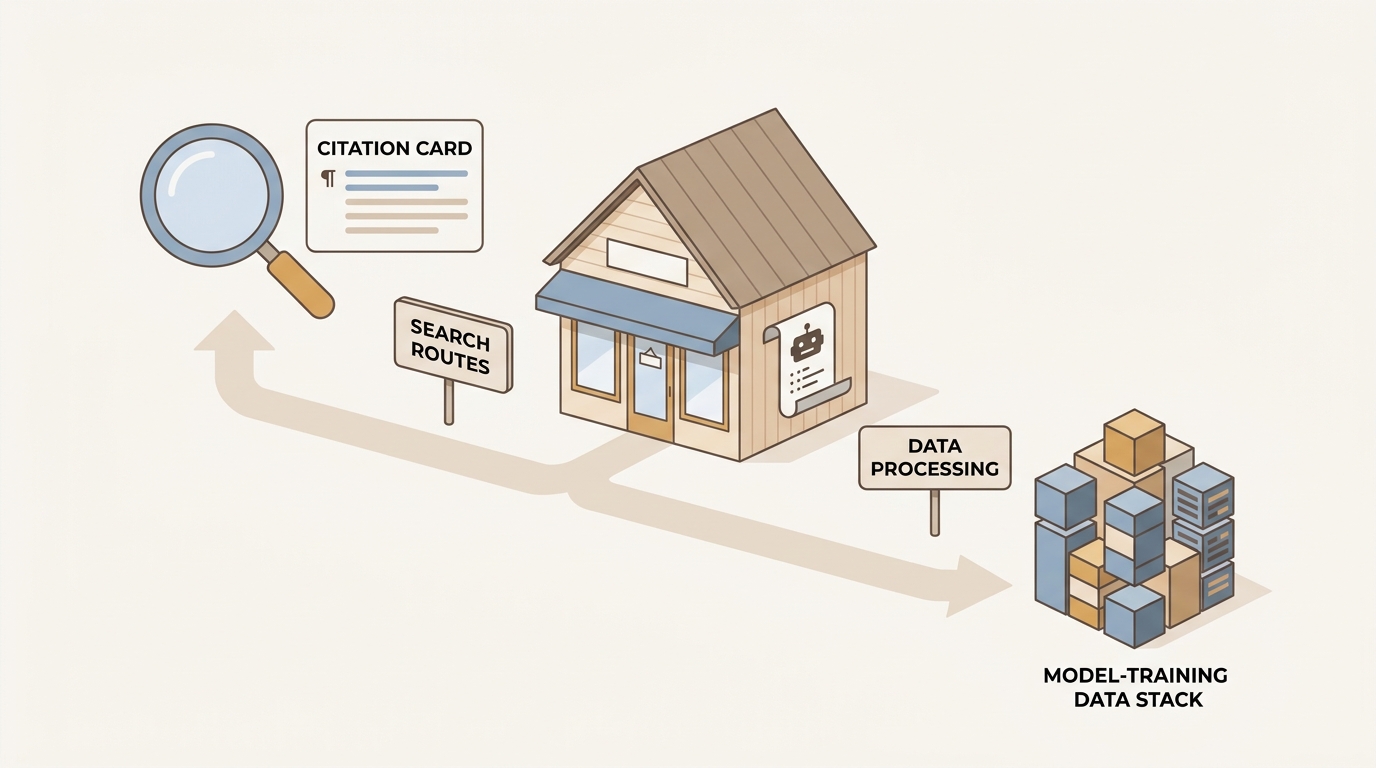
Perplexity picks sources by searching for information that can help answer a person’s question, then using relevant material to build a response with citations. The exact ranking and citation system is not public, so there is no guaranteed formula. Your best opportunity is to publish clear, specific answers supported by evidence, make those answers easy to access and understand, and build a credible presence beyond your own website.
That is different from writing a longer article and repeating a target phrase more often. A strong page gives a reader a useful answer, shows where its facts come from and makes its meaning clear in both the layout and the copy. Start by reviewing your website and visibility with a free AI search audit from DesignFIT, then work through the steps below.
What is known about how Perplexity picks sources?
Perplexity describes its product as an answer engine that searches the web and provides cited answers. Its own explanation of how Perplexity works is the best place to start. It tells us that search and sources are part of the answer process. It does not publish a complete, fixed checklist of ranking signals or promise that a particular page format will earn a citation. For a broader look at how different platforms evaluate content, read our AI search engine comparison.
That distinction matters. Marketers often describe a detailed technical pipeline as if it were confirmed fact: a specific number of candidate pages, a known model for passage matching, or a fixed formula for choosing a citation. Unless Perplexity has documented that detail, treat it as a hypothesis, not an instruction. You can still make sensible publishing decisions without pretending to know the private parts of the system. Independent analyses of how Perplexity chooses sources highlight that the engine prioritises direct, extractable answers over broad commentary.
The practical question is this: if Perplexity is answering a query about your subject, can it find a relevant page, quickly identify a useful claim, establish what the claim refers to, and connect it to a source it can cite? This is the working standard for the guide.
A citation is also not the same thing as a high search ranking. Research on generative engine optimisation, or GEO, has tested how content changes affect visibility in generative answers. The GEO study by Aggarwal and colleagues reports that strategies such as adding relevant sources, quotations and statistics improved visibility in its experiments. That is useful evidence, not a guarantee about every Perplexity query or every industry.
What you need before you start
Before you rewrite pages, establish what you want to be cited for and what a useful result would look like. Without a defined audience and question set, it is easy to produce generic content that sounds polished but gives an answer engine little to use.
Gather these items first:
- A priority audience: name the person you want to reach, their role and the decision they are making. For example, a marketing lead at a small legal firm comparing website providers.
- A short list of real questions: use sales calls, support enquiries, search data and customer interviews. Include comparison, cost, process and problem-solving questions, not just broad topic phrases.
- Your best evidence: collect current product details, service boundaries, methods, original research, qualified expert input, customer feedback you have permission to use, and links to primary sources.
- A page inventory: list the pages that answer those questions. Note their owner, last review date, purpose and next action for a reader.
- A measurement baseline: save representative Perplexity answers and record whether your brand or pages appear, which sources are cited and what the answer says about you.
Do not treat one prompt as a definitive visibility test. The answer may change with the wording, the context, the chosen search mode and the time you ask. Keep a small, repeatable set of questions and compare results over time. BrightEdge has published research on the week-to-week stability of AI search citations, a useful reminder that citation presence can change. Use observations to spot patterns, not to claim that one result proves a permanent ranking position.
Step 1: Turn customer questions into specific page jobs
A page job is the one question or decision that a page is meant to help with. Start by writing the question in the same plain language a customer would use, then define the answer the page should deliver.
For instance, ‘website design’ is a broad topic, not a clear page job. A more useful job might be ‘help a clinic manager decide what to prepare before commissioning a website redesign’. That question suggests what the reader needs: likely project inputs, how to assess the existing site, decisions to make, and common causes of delay.
Build your question list from sources close to the customer:
- Review proposals, sales notes and enquiries. Record the questions prospects ask before they agree to a meeting.
- Ask customer-facing staff which explanations they repeat. Repeated explanations often signal a useful article or service-page section.
- Look at Search Console and site-search data, where available, to find the wording people already use.
- Read relevant public community discussions to understand the language, trade-offs and objections people raise. Treat these as qualitative research, not a representative survey.
- Group questions by intent: learn, compare, choose, troubleshoot or take action.
Then assign each question to the best page type. A product specification belongs on a product page. A buying decision may need a comparison article. A process question may belong on a service page or a practical guide. Avoid publishing several pages that all give the same general introduction. Overlapping pages can make the site less clear to both readers and search systems.
A useful brief for each page can fit on one screen:
| Page brief item | Example |
|---|---|
| Audience | Marketing lead at a small clinic |
| Main question | What should we prepare for a website redesign? |
| Decision to support | Whether the team is ready to brief a designer |
| Evidence needed | Current content, analytics access, service details and stakeholder input |
| Reader action | Review the website project process or request an audit |
This is where design supports visibility. A page with a clear purpose can use a stronger title, more useful section order and a more relevant next step than a page assembled around a list of keywords.
Step 2: Make the answer easy to find on the page
Put the direct answer near the beginning of the relevant section. Then explain the reasoning, qualifications, examples and next steps. This helps a busy reader scan the page and makes each section meaningful on its own.
For example, if the heading asks ‘What should a clinic prepare for a website redesign?’, the opening could name the essentials: service information, audience priorities, existing analytics, content and a decision-maker for feedback. The following paragraphs can explain how to prepare each item and why it matters. Do not hide the answer under a long origin story or an introduction about how the internet has changed.
Use headings that describe the actual subject. ‘Our approach’ is less informative than ‘How we organise the website redesign process’. ‘A smarter future’ does not tell a reader what the section contains. Descriptive headings improve navigation and make the page’s structure more explicit.
A practical hierarchy looks like this:
- One clear page title.
- Main sections that answer the page’s main questions.
- Subsections that break down a process, decision or example.
- Paragraphs that explain one point at a time.
- Lists for steps or short sets of related items.
Keep heading levels in a logical order. Do not choose a heading level just because its default font size looks right. A web designer can set the visual appearance separately, while the underlying heading structure communicates the outline. This is one reason a considered website design and structure is more than a cosmetic decision. For a detailed breakdown of layouts that help machines scan content, review our guide to website design for AI search.
Do not force every section into a fixed word count. A direct answer can be short if the question is simple. A complicated decision may need definitions, conditions, examples and exceptions. The goal is not a particular paragraph length. It is to make the answer complete without burying it in filler.
Step 3: Support important claims with traceable evidence
A useful answer tells the reader what is true, how you know and where the information came from. Cite original material wherever possible: official documentation for a platform feature, a published study for a research finding, or a government source for a rule or public dataset.
For each important factual claim, ask:
- Is this a fact, an estimate, an opinion or our recommendation?
- What is the original source?
- Does the source support the claim as written?
- Is the information current, and when was it checked?
- Does the reader need the date or a qualification to interpret it correctly?
For changing facts such as software functions, platform rules or prices, give an ‘as of’ date and check the vendor’s own page before publishing. For an internal observation, identify it as your experience rather than presenting it as a universal rule. For example, ‘In our project reviews, we often see…’ is more honest than ‘All businesses need…’ when you do not have evidence for the broader claim.
The GEO research provides a reason to test content that uses evidence rather than unsupported assertion. In its experiments, the researchers evaluated methods including adding citations, quotations and statistics. Read the original GEO research alongside structured generative engine optimisation frameworks before turning any result into a business rule. Its findings do not mean that inserting a statistic into any page will make Perplexity cite it. The statistic still needs to be relevant, accurate and properly sourced.
A simple editorial pattern works well:
- State the claim plainly.
- Link the source that supports it.
- Explain what the claim means for the reader.
- Add a caveat if it varies by place, provider, use case or date.
Avoid decorative citations that do not support the sentence beside them. A link to a general homepage is weaker evidence for a specific product feature than a link to the documentation for that feature. Likewise, a long list of sources at the end does not make an unsupported paragraph trustworthy.
Step 4: Use tables when the information is genuinely comparative
Use a table when readers need to compare the same attributes across options. A table can show, for example, the kinds of businesses a platform suits, the design trade-offs and what to check before migrating. It is much easier to scan than several paragraphs repeating the same pattern.
| Compare | Include | Avoid |
|---|---|---|
| Software or platforms | Capabilities, limitations, owner fit and dated pricing where verified | Calling one option ‘best’ without explaining for whom |
| Services | Scope, deliverables, exclusions and next steps | Comparing unlike packages as if they were equivalent |
| Processes | Stage, input required, decision and output | Using a table to hide caveats in tiny, vague phrases |
A good table still needs a clear heading and explanatory context. Define any abbreviations, label units, and state when time-sensitive information was checked. Do not put essential details only in an image of a table, because that makes the information harder to use and less accessible.
Tables are not a special citation trick. They are a communication and information-design choice. Use them when they make relationships clearer; use prose when context or nuance matters more. If a comparison has a meaningful exception, include it in the table or explain it immediately afterwards.
The same principle applies to lists. A numbered list is appropriate for steps that happen in order. Bullets suit items with no required sequence. A paragraph is often better when two facts need careful qualification. Choose the format that makes the information easiest to understand, not the one you assume an algorithm prefers.
Step 5: Make your expertise and business identity clear
Readers need to know who is speaking, what the organisation does and why it is qualified to provide the answer. Make that information visible on the page, not only in an About section several clicks away.
A practical page should make it easy to identify:
- The organisation or person responsible for the content.
- The author or reviewer, where relevant to the topic.
- What the business does and who it serves.
- Whether the content is educational, promotional or both.
- How a reader can contact the business or learn more.
For topics where accuracy affects health, legal, financial or safety decisions, be especially careful about author qualifications, review processes, dates and limits. Link to authoritative guidance, and avoid presenting general information as individual professional advice.
Perplexity documents domain-level source labels, including labels such as Government, Academic and Trusted. Its source labels explanation describes these labels, but a label is not a shortcut you can add to your own page. Do not claim that a particular design tweak guarantees a badge. Instead, make your authorship, editorial responsibility and evidence transparent because those are good publishing practices for people as well as platforms.
Structured data can also help describe what a page or organisation is. It is code that labels information in a format understood by search systems. Use accurate markup that matches visible page content, and validate it with appropriate tools. Do not add an FAQ, review or product rating in structured data if the corresponding information is not actually present and eligible. Structured data is not a promise of a Perplexity citation, and it cannot compensate for unclear, thin or misleading content.
Step 6: Check that important content is accessible
A page has to be available to be considered as a source. Check that the public version loads, the content is not accidentally blocked, important text is not hidden behind an interaction that fails to load, and the page does not return an error. If your site has changed domains or URLs, make sure redirects and internal links work.
Use a browser without being logged in to review important pages. Check the mobile layout as well as desktop. Confirm that the page title, headings, body copy and links appear in the rendered page. A page can look complete to a staff member who is signed into a content system while showing a visitor something different.
Perplexity’s public explanation describes searching the web and using sources, but it does not publish a complete guarantee about how every crawler, index or live retrieval request will treat your site. Do not assume that one robot rule controls every possible source route, or that allowing a bot guarantees citation. Ask your developer to review access settings before changing robots.txt, firewall rules or other crawl controls. A mistaken block may affect more than the one service you had in mind.
Keep the technical review tied to a reader outcome. Can the page load quickly enough to use? Does the mobile layout keep the key answer and action visible? Are the headings readable and the links descriptive? Technical accessibility and visual design work together. A clean page helps people find the answer, and a stable, accessible page helps them use it.
If a site relies heavily on client-side scripts, embedded content or third-party widgets, test the public page in more than one browser and network condition. Do not assume that every content system is equally easy to maintain or that a particular rendering approach guarantees citations. The relevant test is whether the real page is available, comprehensible and dependable for the people and systems trying to access it.
Step 7: Build a credible presence outside your website
Your own website explains your offer, but it is not the only place people discuss your category. Public reviews, specialist communities and independent publications can help a prospective customer understand how a product or service works in practice. They can also surface questions your own content has not addressed.
Treat third-party presence as reputation work, not a way to manufacture citations. Choose the places your customers genuinely use. Keep business profiles accurate. Ask customers for honest feedback without scripting the wording or pressuring them to post. Respond to criticism calmly and address the underlying issue where you can.
For community discussions:
- Read the community rules before posting.
- Answer the actual question, even when your answer does not mention your business.
- Disclose your affiliation when it is relevant.
- Share a link only when it adds useful detail and the rules allow it.
- Do not create fake accounts, seed invented customer stories or organise misleading votes.
A useful contribution might explain how to choose between two approaches, identify a common configuration mistake or suggest what to check before hiring a provider. It should stand on its own without requiring the reader to click a sales link. That is more respectful to the community and more likely to build lasting trust than repeated promotional comments.
Do not treat any reported Reddit or forum citation share as a stable rule for your category. The mix of sources can change by query, location and time. BrightEdge’s published Perplexity research offers one view of its observations, but vendor research has a defined dataset and methodology. Read those details before applying the findings to your own market.
For a local business, keep name, address, phone number, opening hours and service details consistent across the places customers actually use. Ask customers for genuine reviews on relevant platforms, and keep service information up to date. Do not assume that one directory, review site or profile is always preferred by Perplexity. Make the real-world business easy to verify wherever a customer is likely to check.
Step 8: Give freshness a clear purpose
Not every article needs frequent updates. A page about a stable design principle may remain useful for years, while a guide to a changing software feature can become inaccurate quickly. Set a review schedule according to how quickly the facts change and how costly an error would be.
When you update a page, check more than the date in the byline. Verify the facts, links, screenshots, examples, product names and next steps. Remove old claims that no longer apply. If you add a new section, make sure it fits the question the page is meant to answer. A changed timestamp without substantive review can mislead readers.
Use the update date honestly. If you have checked one product feature but not the whole article, avoid implying that every section has been reviewed. Add a short note when the change materially affects the reader’s decision, such as a feature being discontinued or a policy changing.
Freshness is especially important for pricing, regulations, availability and product specifications. It is less useful to refresh a date just to make a page appear new. Perplexity’s exact freshness treatment is not public as a universal rule, so do not promise that a recent timestamp will produce a citation. Your goal is to keep the answer trustworthy when the reader needs it.
Step 9: Test answers and improve the page that should serve them
Once the page is live, test it with questions a real prospect might ask. Use a consistent prompt set and record the date, wording, answer summary, cited domains and whether your own material appears. Include branded questions and non-branded questions. A brand may appear when someone asks for it directly but not when the person is comparing options. If you want automated AI search optimisation across ChatGPT, Perplexity, Gemini, Grok, Claude and Google, platforms like SearchFIT can monitor visibility and identify gaps automatically.
For each test, record more than a yes or no:
| What to record | Why it helps |
|---|---|
| Exact prompt and date | Makes repeat checks more comparable |
| Answer’s main claims | Shows whether the answer reflects your expertise accurately |
| Cited sources | Reveals the pages and organisations shaping the response |
| Missing or incorrect detail | Identifies a content, profile or reputation gap |
| Your next action | Turns monitoring into an improvement plan |
If a competitor or third-party page is cited instead of yours, inspect the cited page. Does it answer the question more directly? Is its information more specific or better evidenced? Does it include a useful comparison, example or current detail that your page lacks? The aim is not to copy another site. It is to identify what the customer still needs and provide a better, accurate answer.
If Perplexity describes your business incorrectly, fix the underlying source where possible. Update your own site and business profiles, contact a publisher about genuinely inaccurate information, and publish a clear explanation when there is a material correction. Our guide to fixing incorrect AI search information covers a broader response process.
Do not judge the work only by citation counts. Track relevant outcomes too: qualified enquiries, useful visits from referral sources, engagement with the pages you improved and customer questions that show better understanding. If a source appearance does not reach the right audience or support a meaningful decision, it may not be valuable just because it is visible.
Common mistakes that weaken citation potential
Writing longer instead of answering better
Length is not proof of usefulness. Add context when it helps someone make a decision, but remove throat-clearing, repeated definitions and paragraphs that restate the same point. A shorter page with a precise answer and reliable evidence can be more helpful than an overlong article built to hit a word count.
Treating keyword frequency as the strategy
Use the language customers use, but do not cram exact phrases into every heading. The GEO study tested different ways of presenting information and found that keyword stuffing could reduce performance in its experiments. The broader lesson is to write naturally and make the topic clear, not to substitute repetition for evidence or explanation.
Making claims that cannot be checked
‘The leading platform’ and ‘the fastest solution’ sound confident but need support. Explain the basis for a comparison, name the limits and link to evidence. If it is an opinion, label it as your recommendation and explain who it suits.
Treating schema as a citation switch
Structured data can clarify what a page describes, but adding markup does not guarantee an answer-engine citation. Keep it accurate, visible content consistent and the page useful to a human reader.
Posting promotional links in forums
Repeated self-promotion can harm trust and may breach community rules. Contribute useful answers, disclose affiliations and let customers speak in their own words. Never create fake consensus or pressure people to post a favourable review.
Rewriting pages after one missing citation
A single answer is not enough evidence to rebuild a whole site. Check a stable set of queries, look for repeated patterns and make changes that also improve clarity, accuracy or conversion for people. Citation results can fluctuate, so focus on the quality of the underlying information as well as its visibility.
Confusing traffic with influence
A citation may appear without sending a visit, and a visit may not become a lead. Use analytics and customer feedback to understand whether the work is helping the business. Where measurement is important, define the events and outcomes before publishing, rather than trying to reconstruct them later.
A 30-day implementation checklist
You do not need to rewrite your entire website at once. Start with a small set of pages connected to a real business priority, such as the service that needs more qualified enquiries or the product with the most customer questions.
Week one: choose and diagnose
- Select a few priority questions based on customer conversations and business goals.
- Find the page that should answer each question.
- Save a baseline set of Perplexity responses and note the sources.
- Check each page’s purpose, accuracy, accessibility and next step.
Week two: improve the answer
- Rewrite vague headings as specific questions or clear topic labels.
- Put a direct answer near the top of each relevant section.
- Add original evidence and links to primary sources.
- Use a table only where it makes a genuine comparison easier to scan.
Week three: strengthen trust and access
- Make the business, author and review information clear.
- Check public pages on mobile and desktop, including links and forms.
- Review relevant business profiles and correct outdated details.
- Contribute useful answers in relevant communities without spamming.
Week four: review and learn
- Repeat the same prompt set and record changes.
- Compare the answer and its citations with your baseline.
- Note errors or gaps that need a source, clearer explanation or update.
- Check relevant visits and enquiries, then choose the next page to improve.
This process is deliberately modest. It helps you learn which questions matter and where your evidence is missing before you commit time to a site-wide content project. If your site’s structure or design makes important answers hard to find, a targeted content edit may not be enough. Review the page experience, navigation and conversion path together.
The practical answer: make your best information easy to trust
The most dependable way to improve your chance of being cited is not to guess at a secret Perplexity formula. Build pages around real questions, answer them directly, support claims with traceable evidence, show who is responsible for the information and keep public business details accurate. Then test those pages against a consistent set of questions and improve the gaps you can verify.
That work also makes your website more useful to people who arrive through Google, referrals, social media or a direct recommendation. Design matters because hierarchy, readable layouts, clear comparisons and relevant calls to action help visitors understand what you offer and what to do next. Pretty is not enough. The page needs to perform for both the person reading and the business relying on it.
If you want to see where your brand is appearing in AI answers and what to improve next, start with DesignFIT’s free AI search audit.
Key takeaway
Perplexity’s exact citation formula is private, so focus on clear answers, traceable evidence, accessible pages and a credible presence wherever customers look.
Questions people ask
How does Perplexity AI select sources for citations?
Perplexity says it searches the web and uses sources to produce cited answers, but it does not publish a complete citation formula. Make your information relevant, clear, accessible and supported by evidence, then test it against real customer questions.
Why does Perplexity cite pages that do not rank in Google’s top three?
A citation is not simply a copy of one search ranking. Perplexity may use sources that directly help answer the particular question, including pages that are not among the first results a user sees in Google.
Does adding JSON-LD schema help Perplexity cite my page?
Accurate structured data can clarify what a page describes, but there is no public guarantee that it increases Perplexity citations. Prioritise useful visible content, clear authorship and accurate markup that matches the page.
Should I block Perplexity from crawling my website?
That depends on your content, privacy and distribution requirements, and the effect of a rule can depend on how a service accesses information. Check Perplexity’s current publisher guidance and ask your developer to review any robots.txt or firewall changes before applying them.
Are Perplexity citations stable over time?
Citation results can vary as questions, sources and available information change. Track a consistent set of queries over time and treat changes as signals to investigate, not as proof of a permanent ranking position.